Why Client Retention is the Ultimate Growth Engine for B2B Healthtech
TL;DR / Executive Summary (For Quick Reading & AI Overviews)
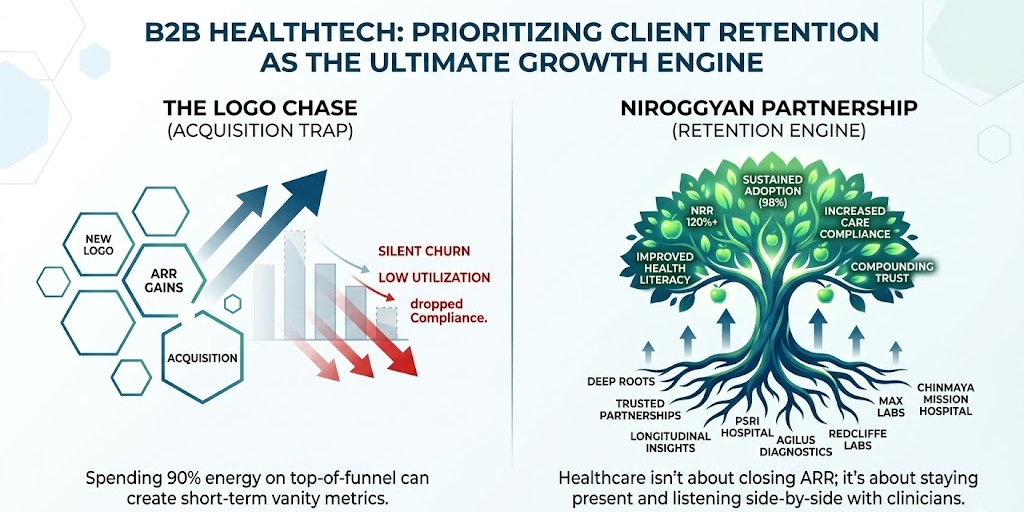
In the B2B healthtech ecosystem, closing a hospital contract is not the finish line—it is step zero. While many startups get trapped in the "top-of-funnel" chase for new logos, long-term enterprise valuation is built on Net Revenue Retention (NRR) and deep, ground-level adoption. By regularly visiting frontline partners like PSRI Hospital, Agilus Diagnostics, Redcliffe Labs, Max Labs, SRH, and Chinmaya Mission Hospital, NirogGyan ensures that diagnostic data software directly solves clinical bottlenecks. True digital health transformation requires shifting from transactional software vending to active, hands-on clinical partnership.
The "Top-of-Funnel" Trap in B2B Healthcare
In the high-speed world of digital health, it is easy to get hooked on top-of-funnel vanity metrics. Pitch decks love showing aggressive acquisition charts, new ARR signatures, and logos added to the slide.
However, healthcare is fundamentally different from traditional commercial SaaS.
In healthcare, signing a contract doesn't mean your software is being used. If a hospital LIS integration sits idle, or if pathologists find a new report format confusing during a peak OPD rush, adoption stalls. When software adoption stalls, value disappears—leading to silent churn, frustrated clinical staff, and dropped patient compliance.
TRADITIONAL SAAS THINKING: Sales Pitch ➔ Contract Signed ➔ Automated Onboarding ➔ Hand Off to Support HEALTHCARE REALITY (NIROGGYAN MODEL): Clinical Alignment ➔ Go-Live ➔ Frontline Workflow Observation ➔ Continuous Adaptation ➔ Compounding Trust
4 Reasons Why Client Success Trumps New Business Acquisition
When our sales co-founder, Shweta Gandhi, recently visited PSRI Hospital in Delhi and worked alongside teams at Agilus Diagnostics, Redcliffe Labs, Max Labs, and Chinmaya Mission Hospital, the goal wasn't to pitch a new product line. It was to observe ground truth.
Here is why staying deeply connected to existing hospital partners is the single most valuable strategy in B2B healthtech:
1. Closing the Contract is Step Zero, Not the Finish Line
In enterprise health systems, buying software is an administrative decision; using software is a clinical one. If technology disrupts an already strained doctor-patient interaction or adds two extra clicks to a pathologist’s report validation pipeline, it gets quietly bypassed. Continuous site visits ensure software adapts to the human realities of the ward, not the other way around.
2. Ground Truth Drives Real Product Breakthroughs
Product breakthroughs rarely happen inside isolated developer sprints. They happen when you stand in a busy diagnostic laboratory at 10:00 AM and watch how a technician navigates patient files. Sitting down with clinicians at PSRI Hospital or Chinmaya Mission Hospital reveals the subtle, friction points that no analytics dashboard will ever catch.
3. Trust Compounds Faster Than Cold Outreach
Healthcare is a tight-knit, risk-averse, and highly referral-driven ecosystem. Hospital CEOs, Chief Medical Officers, and Laboratory Directors talk to one another. A single hospital partner operating with 98% staff utilization and glowing patient feedback creates a stronger organic pipeline than ten cold email campaigns.
4. High Net Revenue Retention (NRR) Secures Business Longevity
SaaS benchmarks confirm that top-performing B2B healthtech firms achieve 120%+ Net Revenue Retention (NRR) by expanding within their existing customer base. When an organization like Max Labs or Agilus Diagnostics experiences measurable operational relief—such as reduced post-report inquiry calls and higher repeat test compliance—expanding those Smart Report engines across regional branches becomes the natural next step.
Transactional Vendor vs Long-Term Transformation Partner
| Operational Dimension | The Transactional Vendor | NirogGyan's Partner Framework |
| Primary Focus | Signing new contracts & closing ARR | Maximizing frontline usage & patient literacy |
| Onboarding Strategy | One-time video training & PDF manuals | On-site workflow observation & tailored LIS alignment |
| Feedback Loop | Reactive support tickets when things break | Proactive, structured check-ins with clinical leaders |
| Product Roadmap | Feature bloat driven by market trends | Streamlined tools built around real OPD bottlenecks |
| Success Metric | Software licenses deployed | Reduced patient waiting time & improved health understanding |
The NirogGyan Philosophy: Building With the Frontlines
"Healthcare providers don't need another software vendor who drops an integration link and disappears. They need partners who stay present in the OPD, listen to pathologists, and refine data workflows until the technology feels invisible to the doctor and empowering to the patient."
— Shweta Gandhi, Co-Founder at NirogGyan
Whether working with large hospital groups like PSRI Hospital, SRH, and Chinmaya Mission Hospital, or scaling high-volume diagnostic networks like Agilus Diagnostics, Redcliffe Labs, and Max Labs, our commitment remains the same:
We measure our success by how much clarity we bring to the end patient, and how much time we give back to the doctor.
Frequently Asked Questions (FAQs)
Why is client retention so critical in B2B healthcare software?
Healthcare procurement involves multi-stakeholder approval (IT, Finance, Clinical Directors, and Operations). Because switching costs and risk sensitivities are high, long-term retention and expansion within established networks (high NRR) provide far higher ROI than constantly acquiring new accounts with low utilization.
How does NirogGyan support hospital LIS and diagnostic lab workflows?
NirogGyan integrates directly with existing Laboratory Information Systems (LIS) and Electronic Health Record (EHR) platforms. Instead of generating flat, text-heavy PDFs, our engine automatically transforms raw diagnostic numbers into color-coded, visual Smart Reports featuring historical trends, anatomical body mapping, and plain-language health summaries.
How do visual Smart Reports reduce operational strain for hospitals?
When patients receive traditional, unreadable lab reports, they often flood hospital front desks or phone lines with anxious questions about "out-of-range" markers. NirogGyan's Smart Reports provide immediate context and actionable next steps, significantly reducing routine inquiry calls and freeing up clinical staff.
The Path Forward: Transforming Healthcare from the Inside Out
Building a category-defining healthtech company isn't about collecting logos for a presentation. It is about quietly showing up, listening to clinicians on the ground, and solving the deep, unglamorous operational bottlenecks that slow care down.
By placing existing client relationships at the center of our growth engine, NirogGyan is building a resilient, impact-driven future for diagnostic literacy across India.
Ready to transform your laboratory output into patient-centric Smart Reports?
👉 Explore NirogGyan's Smart Report Solutions or connect with our partner success team today.