Many laboratories generate detailed clinical data, but patients often struggle to understand their own reports, creating a gap in healthcare communication. Traditional PDF lab reports were designed for record-keeping rather than patient understanding. Moving to smart, AI-powered lab reports helps translate complex data into clearer insights. This shift supports digital transformation while reducing patient confusion and administrative workload.
Key Highlights
- Most patients still receive lab results as a PDF, a format designed for filing, not for understanding.
- Smart lab reports take the same test data and present it in a way that actually makes sense to the person reading it.
- For labs, the shift isn't just about patient experience, it touches turnaround time, error rates, and compliance too.
- A digital lab reporting system automates most of what technicians currently do by hand.
- Clinicians benefit just as much as patients, structured data means less time hunting through attachments.
- Switching doesn't mean scrapping everything. Most labs start with a hybrid approach and expand from there.
Digital Readiness Assessment: Where Does Your Lab Stand?
| Feature | The Legacy State (Traditional PDF) | The Future State (Smart Report) |
| Data Utility | "Frozen" in locked documents | Structured and machine-readable |
| Patient Literacy | Relies on high-jargon "medicalese." | Plain-language health narratives |
| Lab Operations | Manual transcription and entry | Automated instrument-to-report flow |
| Business Intelligence | Limited to volume tracking | Real-time revenue and engagement KPIs |
What Are Smart Lab Reports?
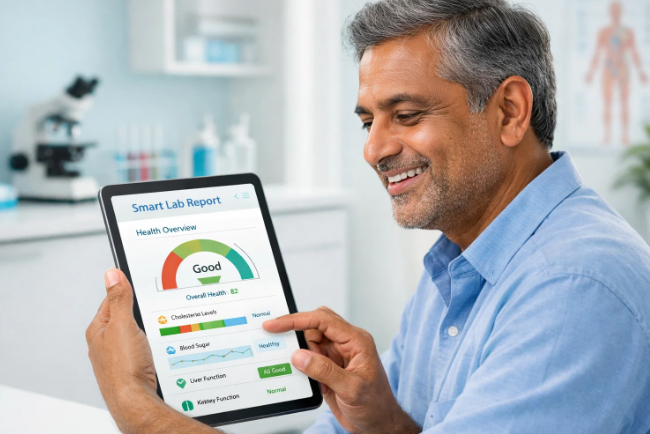
At NirogGyan, we define our smart lab reports as an intelligent reporting ecosystem. By leveraging AI (including GPT-4o mini) for report summarization, we layer visual trends and plain-language explanations over raw clinical data.
Healthcare leaders ask us about the practical difference. Imagine a patient receiving a thyroid panel. In a traditional report, they see "TSH: 6.2 mIU/L" and a small asterisk. Before you digitize, observe the patient's reaction: they squint at the numbers, feel a flash of panic, and head to a search engine.
A smart report transforms that same data point into a visual that places the value in an "above optimal" zone, accompanied by a two-line explanation of what it means and a clear "what to do next" note. It’s the same data, but a completely different experience.
Smart lab reports transform raw diagnostic data into visual insights and easy-to-understand explanations for patients and clinicians.
Explore Smart Lab ReportsWhat Is the Traditional Lab Report Format and Where Does It Fall Short?

The traditional format, patient details at the top, a table of results in the middle, and a signature at the bottom, has served clinicians for decades. For a trained pathologist, this format works perfectly because they know how to spot an elevated ALT at a glance.
However, as a transformation leader, you must recognize that this document now lands directly in patients' WhatsApp messages and health apps. Without the clinical background to interpret a reference range like "0.5 – 5.0," a patient seeing "6.2" has no context for whether to panic or ignore it. This leads to a high volume of support calls to your lab, wasting valuable staff time.
The Static PDF Problem
Beyond readability, there is a structural ceiling to the PDF. It is a locked document. The data inside cannot be queried or automatically compared with a result from six months ago. For labs attempting to build modern workflows, "frozen" PDF data is a significant barrier to clinical decision support.
Smart Lab Reports vs Traditional PDF Reports: A Direct Comparison
When comparing these two paradigms, we look at dimensions that impact your bottom line and your brand equity.
Technology Stack Comparison
- Traditional PDF: Static document; written for clinicians; manual formatting adds delays; human-readable only.
- Smart Lab Report: Dynamic digital report; plain-language and contextual; 66% faster delivery; machine-readable and EHR-ready.
How a Digital Lab Reporting System Changes Lab Operations
The most immediate shift occurs in your back-end efficiency. Currently, your technicians likely take validated results and manually enter them into a template. This introduces manual error risk at every step.
A digital reporting system connects directly to your instruments via secure APIs, picking up results as they are validated and assembling the report automatically.
Modern diagnostic platforms integrate directly with existing LIS systems, allowing labs to automate workflows and eliminate manual report formatting.
View LIS Integration OptionsNirogGyan’s Rapid 4-Day Deployment Roadmap
- Day 1 (Connection): Seamlessly integrate with your existing LIS and data sources.
- Day 2-3 (Automation): Configure report templates and automated workflows tailored to your lab's branding.
- Day 4 (Go-Live): Launch with full onboarding support and begin delivering interactive reports.
Who Benefits and How?
- Patients: They receive an explanation, not just a document. Trend analysis allows them to track their health trajectory over years, which is essential for managing chronic conditions.
- Clinicians: They save time with structured data. Critical values are pre-flagged, and trend data is already visible, allowing for faster decision-making.
- Lab Managers: You gain operational excellence. Faster turnaround times (TAT) and an 95% reduction in manual data entry provide a massive competitive advantage.
Is It the Right Time to Make the Switch?
Healthcare leaders ask us about the risk of disruption. The reality is that smart reporting platforms are designed to sit on top of your existing LIS, not replace it. You don't need to scrap your core processes on day one.
We often recommend a hybrid approach: continue issuing PDFs for legal archiving while introducing smart delivery channels for patient engagement. With cloud-based, volume-based pricing, this transformation is now accessible even to smaller independent labs.
This isn't just theory, Max Lab achieved a 2x revenue increase in 12 months after adopting NirogGyan, as patients actively preferred the smarter, more engaging reports.
Conclusion: Where to Go From Here
The case for smart reporting is simple: the PDF was only designed to meet one need, but modern healthcare has many. Is your lab ready to become a digital health hub?
Executive Implementation Checklist
- Analyze Current Workflow: Identify where manual data entry or delays are most frequent.
- Verify Connectivity: Check if your LIS can connect via secure APIs.
- Request a Live Demo: Use your own report types (e.g., a lipid panel) to see the visual transformation.
- Launch a Pilot: Start with one report type and one delivery channel for one month to measure feedback.
- Confirm Compliance: Ensure the platform meets regional regulatory requirements (CLIA, CAP, etc.).
- Verify if your LIS can connect via secure APIs. NirogGyan integrates seamlessly with leading platforms like CloudLIMS and CrelioHealth using HL7 FHIR R4 standards.
The future of diagnostics isn't just in the test itself, but in how those results are understood and utilized to improve lives.
FAQ’s
1. Why are traditional PDF lab reports difficult for patients to understand?Because they present raw numbers and medical terminology without explanations or visual context.
2. Do smart lab reports improve patient engagement?
Yes, visual insights and plain-language explanations encourage patients to actually review and understand their results.
3. Can smart reports reduce patient support calls to labs?
Yes, clearer explanations reduce confusion, which often lowers the number of patient inquiries.
4. Do smart reports affect lab turnaround time (TAT)?
Automated report generation can significantly reduce delays caused by manual formatting and data entry.
5. Are smart lab reports compatible with hospital EHR systems?
Most platforms including NirogGyan, support structured data formats and API integrations that allow seamless EHR connectivity.
6. Can smart reports include historical trend comparisons?
Yes, they can automatically display trends across multiple tests over time.
7. Will technicians need new training to use smart reporting systems?
Minimal training is typically required because most systems integrate with existing LIS workflows.
8.Are these reports compliant with national missions?
Yes, NirogGyan is designed to be ABDM (Ayushman Bharat Digital Mission) compatible, facilitating the creation of longitudinal health records.
9. Do smart reports support lab branding and customization?
Yes, labs can customize layouts, colors, explanations, and logos to match their brand identity.
10. Can smart reporting help labs differentiate from competitors?
Yes, offering interactive and patient-friendly reports can significantly enhance the patient experience.
“Transform your lab reporting with NirogGyan Smart Reports.”