TL;DR / Executive Summary
Medical diagnostics has perfected biological precision, yet it routinely fails at human communication. When patients receive laboratory results, they are handed dense tables, clinical acronyms, and arbitrary reference ranges designed for billing and clinical archives, not human comprehension.
According to global public health findings and recent research in digital narrative medicine, low health literacy affects over 40% of global populations and up to 90% of Indian adults, driving chronic disease mismanagement and unnecessary healthcare costs. Facts and numbers inform clinicians, but stories move patients.
By combining visual storytelling, interactive anatomical mapping, and conversational AI insights, NirogGyan bridges the communication gap between pathology labs and everyday individuals, turning static test numbers into empowering health narratives.
The Human Brain Is Wired for Stories, Not Spreadsheets
For decades, the standard healthcare transaction has followed a rigid script: a patient feels unwell, provides a biological sample, and receives a multi-page PDF document filled with numbers, decimal points, and reference brackets. From a biochemical standpoint, that document is complete. From a behavioral science standpoint, it is broken.
Cognitive psychology confirms that the human brain does not retain or act on isolated data points. It processes information through narrative frameworks: beginning, conflict, resolution, and personal stakes.
When an individual sees HbA1c: 6.1%, the data point is emotionally flat. It registers as a disconnected technical reading. But when that data point is contextualised as a chapter in their metabolic story, showing where their body was two years ago, how their current dietary habits have created subtle biological drift, and the specific daily habits that can rewrite the next chapter, the data converts into agency. Information alone rarely changes human behaviour. Storytelling creates the emotional bridge that makes change possible.
The Health Literacy Crisis: What the Research Shows
The communication failure in modern healthcare is not an aesthetic issue; it is a global public health bottleneck.
- The Global Literacy Deficit: studies from the World Health Organization (WHO) and international health policy groups indicate that more than a third of adults in developed economies struggle to interpret basic health guidance. In emerging markets like India, research shows that nearly 90% of the population suffers from low functional health literacy, making standard medical records virtually unreadable without professional assistance.
- The Economic Burden: inadequate health literacy accounts for an estimated $100 billion to $238 billion in avoidable healthcare expenditures annually in the United States alone, driven by delayed care, poor medication adherence, and unnecessary emergency visits.
- The Cognitive Fatigue Barrier: research published in digital health journals (such as JMIR and Frontiers in Public Health) demonstrates that when anxious patients encounter technical medical shorthand ("doctor-speak"), their working memory shuts down. The result is cognitive fatigue: patients either panic unnecessarily or file the report away and ignore warning signs.
- The Power of Digital Narrative Medicine: a 2026 study on digital narrative interventions found that presenting diagnostic trends through visual narratives and plain-language summaries improved patient follow-up adherence and chronic disease self-management by more than 30%.
When patients understand their baseline, they become active participants in their care rather than passive bystanders.
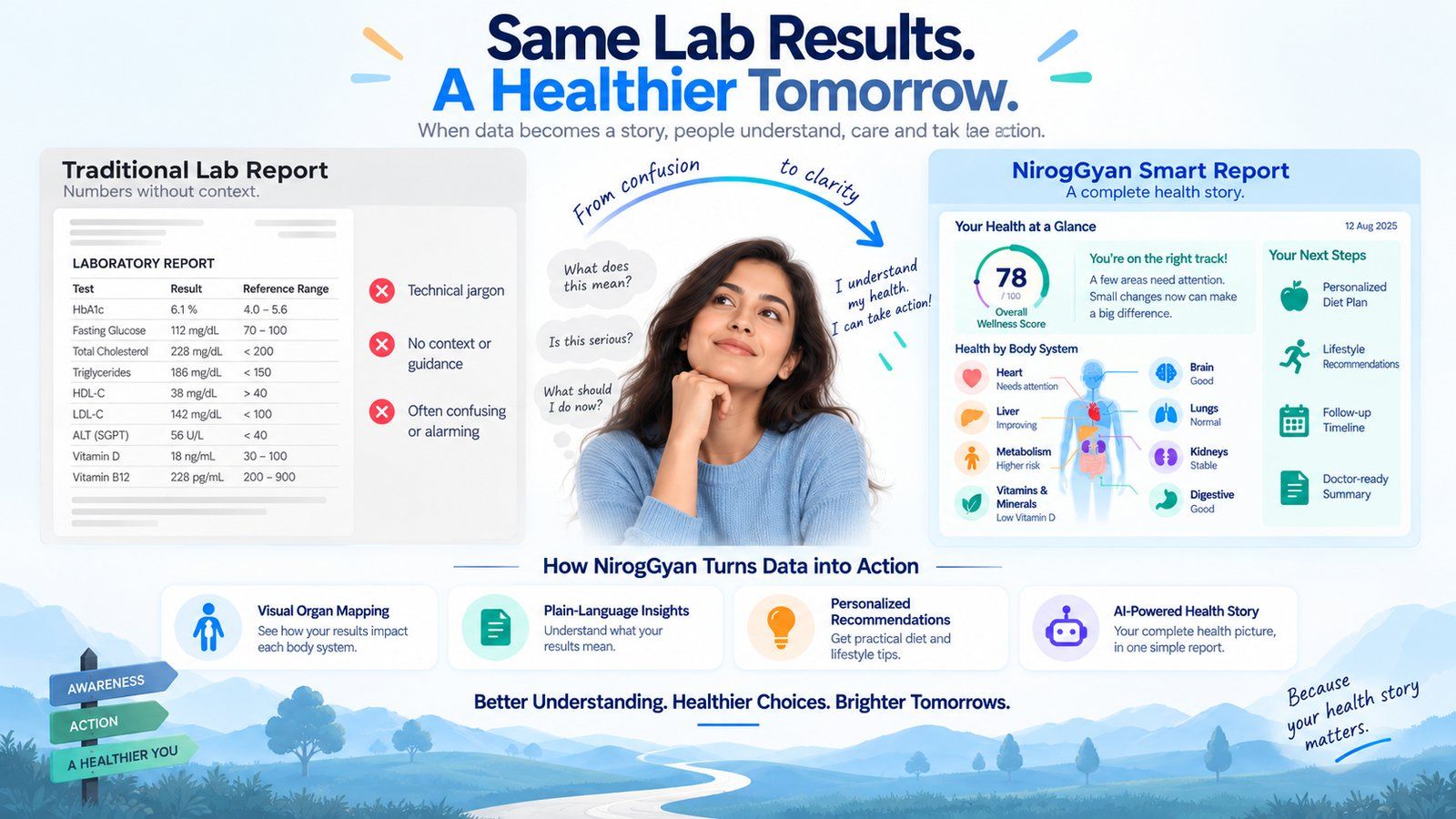
Data vs. Story: Why Traditional Reports Fail the Patient
Traditional diagnostic reports were built for laboratories, insurance billing, and physicians. They were never designed for the person whose blood was in the vial.
| Attribute | Traditional Diagnostic Lab Report | Narrative-Driven Smart Report |
| Format | Dense, black-and-white rows of text | Clean, responsive, visual interface |
| Context | Single-day numeric snapshot | Longitudinal trajectory and historical trends |
| Language | Clinical acronyms (e.g., SGPT, MCV, Non-HDL) | Plain-language explanations of function and cause |
| Risk Depiction | High/Low text flags or red asterisks | Intuitive, colour-coded metabolic spectrums |
| Actionability | Zero lifestyle or preventive guidance | Clear next steps, dietary tips, and doctor-ready questions |
| Emotional Impact | Induces anxiety, confusion, or dismissal | Delivers calm clarity, direction, and agency |
Modern Diagnostic Storytelling: Visual Maps, AI, and Plain Language
Transforming diagnostic data into a compelling health story requires rethinking how information is structured, visualised, and delivered. At NirogGyan, this evolution is built on four core pillars.
1. Visual Organ Mapping (VizApp)
Instead of forcing users to scroll through an alphabetised list of sixty isolated markers, NirogGyan's VizApp groups test results into intuitive anatomical systems (Heart, Liver, Kidneys, Metabolism, Blood, and Micronutrients). By viewing an interactive anatomical body map, a patient can immediately see which organ systems are thriving and which are under metabolic strain, replacing rows of text with spatial clarity.
2. Longitudinal Tracking: Connecting Past, Present, and Future
A story cannot exist without a timeline. A single total cholesterol reading of 195 mg/dL is meaningless without context. Did it climb from 150 mg/dL last year, or did it drop from 240 mg/dL after six months of lifestyle changes? NirogGyan Smart Reports highlight trend lines over time, showing patients the direct consequences of their daily choices and celebrating positive lifestyle shifts before clinical symptoms ever develop.
3. Conversational AI and Vernacular Access
Health literacy must be accessible to everyone, not just English-speaking urban populations. By integrating intelligent summary layers and multilingual capabilities (including Hindi and regional languages), reports can translate clinical concepts like "atherogenic dyslipidemia" or "impaired fasting glucose" into straightforward, everyday language. Patients can ask direct questions: what does this mean for my daily routine, and what questions should I ask my doctor tomorrow?
4. Zero-Friction, Mobile-First Delivery
More than 80% of patients access their health data on a smartphone. Pinching, zooming, and panning across a desktop-formatted A4 PDF creates unnecessary friction. Narrative health reports must be responsive, interactive, and easily deliverable through channels people already use daily, such as WhatsApp and mobile browsers.
Putting Stories in the Hands of Everyday Families: The B2C Analyzer
While NirogGyan works directly with leading diagnostic networks and hospital systems to upgrade their reporting pipelines, we recognised that millions of patients already have older, static lab reports sitting forgotten in their email inboxes. To solve this, we launched the NirogGyan Lab Report Analyzer.
For a minimal amount, an individual can upload an existing blood test PDF from any diagnostic laboratory and receive a Consolidated Smart Report:
- A single, unified view: of their overall health profile.
- Automatic calculation: of vital ratios that standard reports leave out, like the TG:HDL ratio.
- Jargon-free explanations: of borderline markers.
- Concrete lifestyle guidance: and informed questions prepared specifically for their next doctor's appointment.
By removing the price and technical barriers to health literacy, we ensure that anyone can transform a confusing medical document into a personal roadmap for wellness.
Why Healthcare Providers and Diagnostic Labs Win with Stories
For diagnostic laboratories, clinics, and hospital networks, shifting to storytelling is not just about patient satisfaction; it is an operational and commercial advantage.
- Drastic reduction in operational friction: when reports are self-explanatory, laboratory front desks and call centres receive fewer frantic calls from confused patients demanding interpretations for minor out-of-range flags.
- Higher patient activation and compliance: patients who understand the narrative behind their test results are significantly more likely to book follow-up consultations, adhere to prescribed therapies, and return for scheduled re-testing.
- Brand differentiation in a commoditised market: diagnostic providers that deliver actionable, beautiful, and empathetic reporting build lasting brand loyalty and trust.
Frequently Asked Questions
What is narrative medicine in the context of diagnostics?
Narrative medicine in diagnostics refers to translating raw biomarker figures and clinical reference ranges into a cohesive, patient-centred health story. It explains what the numbers mean, how they relate to daily lifestyle habits, and what actions an individual can take to protect their long-term health.
Why are traditional lab reports difficult for non-medical people to understand?
Traditional reports were historically developed for laboratory technicians, physicians, and medical billing records. They rely on clinical shorthand, complex units of measurement, and broad reference ranges, offering little to no context regarding what a borderline reading means for everyday living.
How does the NirogGyan Lab Report Analyzer protect patient privacy?
NirogGyan adheres to strict healthcare data privacy and security standards. Uploaded laboratory records are processed securely to extract and visualise biomarker data, ensuring that sensitive personal health information remains confidential and protected.
Can storytelling replace a doctor's consultation?
No. Diagnostic storytelling and smart reports are designed to enhance health literacy, not replace clinical judgment. By educating patients on their biomarkers ahead of time, these tools empower individuals to have more focused, collaborative, and productive conversations with their treating physicians.
The Future of Health Is Human
Healthcare data will continue to grow exponentially in volume, complexity, and precision. From routine complete blood counts to advanced genomic sequencing, we have more biological information about the human body than at any point in history. Yet data without understanding remains inert.
When we give numbers a narrative, we turn confusion into clarity, anxiety into action, and clinical data into genuine preventive care. That is why storytelling matters in healthcare, and that is what we build every day at NirogGyan.
Ready to transform your diagnostic data into a clear, visual health story?
Try the Lab Report Analyzer Free