How to Make Your LIMS Work For You
Key Takeaways:
- A LIMS is only valuable when aligned with your operational needs, compliance standards, and growth goals.
- Common pain points in labs include manual errors, staff overload, poor instrument integration, and limited audit readiness.
- Choosing the right LIMS means focusing on usability, compliance support, automation capabilities, and scalability.
- Effective use of LIMS requires regular audits, team training, automation setup, and system customization.
- Modern LIMS platforms (like LabWare, STARLIMS, CrelioHealth, MocDoc, Scispot, and QBench) vary widely in features-select based on your lab size, scale, and goals.
- LIMS can become a business growth engine when used to power patient engagement, branding, performance insights, and predictive analytics.
Are You Getting the Most Out of Your LIMS?
In the fast-evolving world of diagnostics, efficiency is a necessity. Diagnostic labs in India, both small and large, face mounting pressure to reduce turnaround time, maintain compliance, keep costs low, and ensure a high standard of patient care. At the center of this ecosystem is the Laboratory Information Management System (LIMS).
If your team still relies on spreadsheets, spends hours tracking down reports, or faces compliance headaches during audits, your LIMS might be holding you back more than helping you.
The disconnect between expectations and the reality of integrating LIMS software often lies in poor implementation, lack of staff training, or choosing a system that doesn’t align with operational workflows.
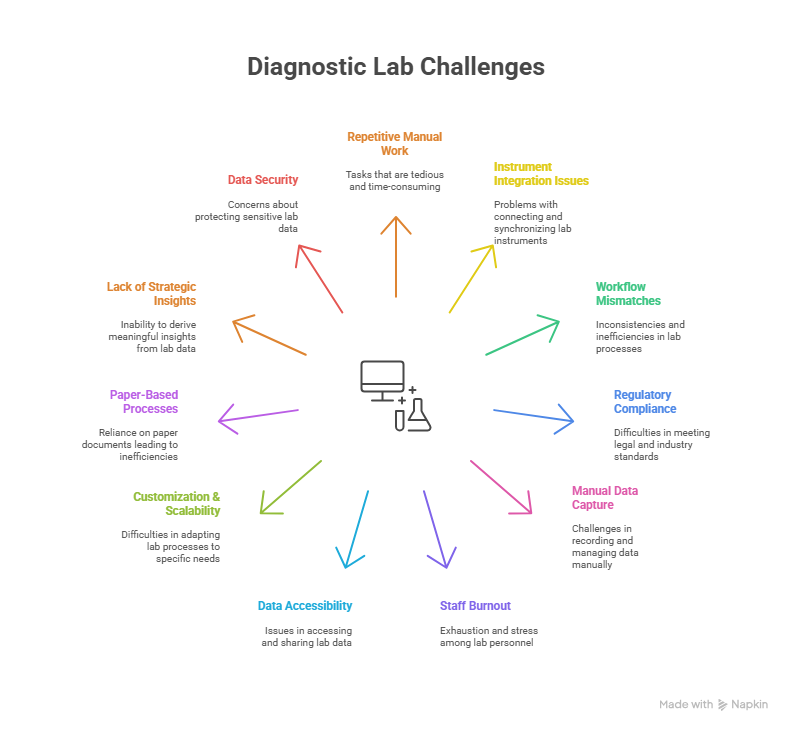
Common Operational Pain Points:
- Repetitive manual work despite having a LIMS
- Instrument integration missing or broken, leading to double entry
- Workflow mismatches between the lab’s processes and what the LIMS supports
Ask Yourself:
- Are reports being generated and delivered automatically?
- Can you track each sample’s journey in real time?
- Do you have to call your vendor for every small update?
- Is patient data being securely stored and easily retrieved during audits?
If the answer is “no” to most of these, your LIMS needs attention.
The Business Impact of an Underperforming LIMS
An inefficient LIMS can drain your resources, limit growth, and impact patient satisfaction.
Hidden Costs:
- Time wastage: Hours spent on data entry
- Revenue leakage: Missed follow-ups, report delays, and billing errors
- Low productivity: Bottlenecks in high-volume seasons (e.g., health camps, outbreak seasons)
- Poor patient experience: Delayed or missing reports, lack of digital access
Strategic Risks:
- Non-compliance with NABL or ICMR standards
- Fragmented data that prevents meaningful insights
- Inability to scale lab operations across multiple locations
A modern, efficient LIMS should reduce costs, improve turnaround times, and support your business strategy.
Choosing the Right LIMS: What to Look For
Selecting the right LIMS can feel overwhelming, especially with a growing number of vendors in the market. It is important to make the right choice based on cost, adaptability, and ease of adoption.
| If Your Problem Is: | What You Should Look for in Your LIMS: |
| Regulatory Compliance & Risk Management | Electronic records with audit trails and ALCOA+ compliance, Role-based access and electronic signatures, Built-in SOPs and document version control |
| Manual Data Capture & Environmental Monitoring | Integrate RMS (remote monitoring systems) directly with LIMS, Auto-capture of sensor data and real-time alerts for deviations, Compliance-ready logs for inspections |
| Instrument Integration & Workflow Automation | Plug-and-play integration with analyzers and barcode scanners, Automated test result uploads, calibration tracking |
| Staff Burnout & Inefficient Workflows | Automate patient registration, sample tracking, report generation, Auto-notifications for result readiness via SMS/WhatsApp, Dynamic workload dashboards for optimal technician scheduling |
| Data Accessibility, Traceability & Audit Readiness | Centralized, searchable database with traceable logs, Field-level audit trails and report versioning, Real-time dashboards for management visibility |
| Customization & Scalability | Modular design and low-code configuration, Add or modify workflows without vendor dependence, Scales with franchises, chains, or multi-department labs |
| Paper-Based Residual Processes | Digitize all documents, training modules, and CAPA workflows, Auto-notifications and e-approvals ensure timely corrective action |
| Lack of Strategic Insights | Dashboards for TAT tracking, repeat business, peak volumes, Use data to create smart test packages and patient engagement campaigns |
| Data Security & Reliability | End-to-end encryption, cloud backups, and access controls, Regular validation ensures uptime and trust during inspections |
This thorough feature comparison between popular LIMS vendors can help narrow down options:
| Vendor | Best For | Standout Features | Pros and Cons |
| LabWare LIMS | Large, regulated or multi-branch labs | Highly customizable; strong compliance; deep instrument integration | Interface for technicians, Compliance (ALCOA+, electronic signatures), RMS/instrument support, Scalable and customizable, but complex and requires training |
| STARLIMS | Enterprises needing analytics & mobile interface | Complete quality management; robust compliance; great mobile/dashboards | Role-based UI, Audit-ready and ISO compliant, Workflow automation, Interface dated; heavy implementation |
| CrelioHealth LIMS | Small-to-mid sized clinical labs in India | Cloud-native; patient portal; WhatsApp/SMS delivery; multi-location | Easy UI, Instrument + HIS integration, Compliance (NABL), Patient engagement built-in, Less advanced analytics |
| MocDoc LIMS | Indian diagnostic centers scaling to chains | HIS/TPA integration; dashboarding; 24/7 Indian support | GST/NABL readiness, Instrument + HIS + CRM integration, Cloud backups & compliance-ready, Local vendor support |
| Scispot | Research/diagnostic labs needing speed & cloud | Cloud-native; no-code workflows; API-first; AI-aided integration | User-friendly, Modular, instrument + RMS integration, Dashboards + AI, Fast deployment, less IT overhead |
| QBench | Labs prioritizing ease of use and quick setup | Highly rated for usability; inventory + LIMS in one | Simple UI, Good for small teams, Might lack deep compliance/instrument modules |
| Labguru / SciNote | Academic or smaller R&D labs | ELN + LIMS combined; accessible pricing | Cloud-based, Good for documentation and sample tracking, Limited instrument integration and analytics |
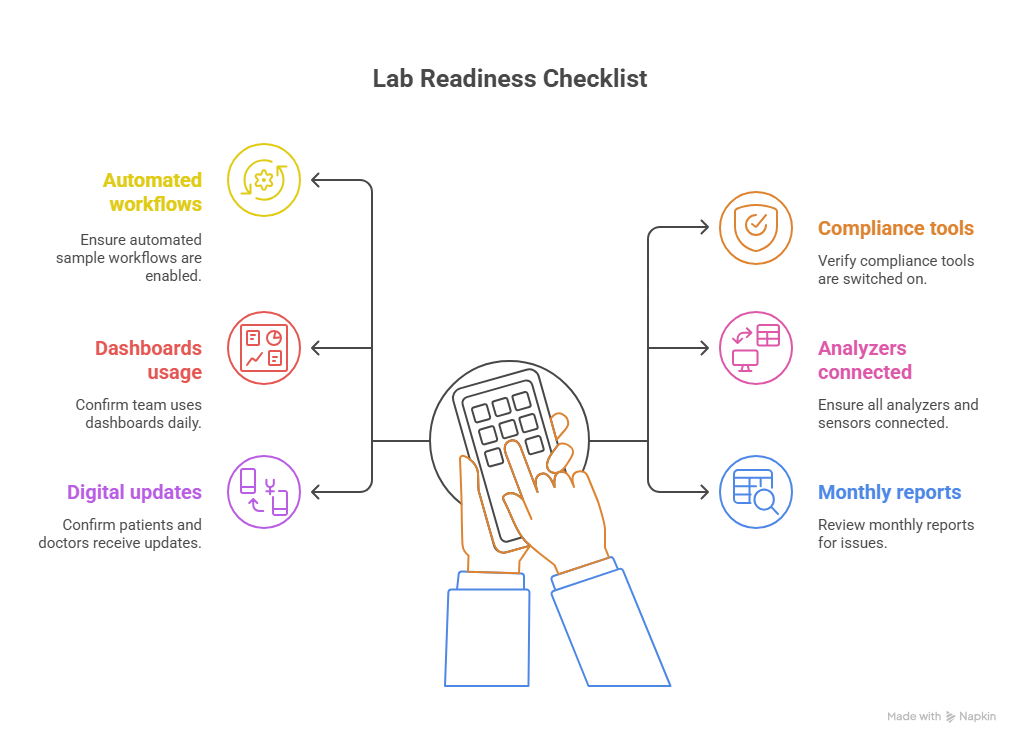
Making It Work: Practical Optimization Checklist
Whichever LIMS fits the best for your lab, it is important to ask these questions:
- Have I enabled automated sample workflows from collection to report?
- Are compliance tools (audit trail, ALCOA, electronic signature) switched on?
- Is my team using dashboards to make daily operational decisions?
- Have I connected all analyzers and environment sensors?
- Do patients and doctors receive digital updates automatically?
- Am I reviewing monthly reports to identify leakages, delays, or staff issues?

LIMS as a Business Growth Enabler
Leverage LIMS Data for:
- Identifying top-performing packages and promoting them online
- Recognizing common test patterns and seasonal peaks
- Tracking repeat customers and sending re-engagement messages
Boost Your Branding:
- Use white-labeled, mobile-friendly reports with your lab’s name and logo
- Offer digital health records for returning customers
- Send health reminders and follow-up suggestions using LIMS data
By combining data and digital engagement, you position your lab as an end-to-end partner in wellness.
The Future of LIMS: Beyond Operations
For CTOs and innovation officers, the future of LIMS lies in data intelligence and platform capabilities.
Future-Ready Features:
- AI-enhanced reporting (e.g., risk markers flagged based on history)
- Predictive analytics to forecast test demands
- APIs for third-party integration with apps, wearables, or health platforms
- Real-time dashboards for multi-branch monitoring and benchmarking
As India’s diagnostics ecosystem digitizes, your LIMS must evolve from a record-keeping tool to a data platform.
FAQs(Frequently Asked Questions)
1. How do you use LIMS step by step?
Using a LIMS typically follows these steps:
- Log in with secure credentials.
- Register samples with patient or project details.
- Label and barcode samples for tracking.
- Assign tests and link instruments.
- Record results either manually or via integration.
- Review and approve results with QC checks.
- Generate and deliver reports (PDF, SMS, portal).
- Archive data for compliance and future access.
2. How to extract data from LIMS?
Data can be extracted from LIMS using built-in reporting tools, custom queries, or export functions. Most systems support downloading data as CSV, Excel, or PDF files. Advanced LIMS platforms offer APIs for real-time data extraction and integration with BI tools. Users can also generate scheduled or on-demand reports filtered by test type, date, patient ID, or other parameters.
3. What is the LIMS workflow?
A LIMS workflow is the structured digital path that a sample follows from registration to reporting. It includes steps like sample receipt, test assignment, data entry or instrument integration, quality control, validation, report generation, and archiving. These workflows are customizable and help enforce SOPs, reduce manual errors, and ensure regulatory compliance across lab operations.
4. What are the four steps in implementing a LIMS system?
- Needs Assessment & Planning - Define goals, regulatory needs, and key workflows.
- System Selection & Configuration - Choose a LIMS and customize it to fit your lab.
- Testing & Validation - Run test cases to ensure accuracy, compliance, and performance.
- Training & Go-Live - Train staff, migrate data, and roll out the system lab-wide.
5. How is data stored in LIMS?
Data in LIMS is stored in a secure, structured database, often relational (e.g., SQL). It includes metadata, test results, timestamps, audit trails, and user activity logs. Modern LIMS use cloud or hybrid storage, offering encryption, backups, and role-based access control to maintain data integrity and meet compliance standards like NABL or 21 CFR Part 11.
Final Thoughts
A LIMS should not merely store your test data. It should:
- Help you deliver reports faster and more accurately
- Provide real-time insights into technician performance and operational bottlenecks
- Support compliance by design, not as an afterthought
- Enable your team to automate repetitive tasks and focus on quality
- Allow scaling without chaos, whether you're expanding across localities or departments
The LIMS you already have (or plan to implement) can unlock major growth - but only if you actively engage with its capabilities and optimize it regularly.
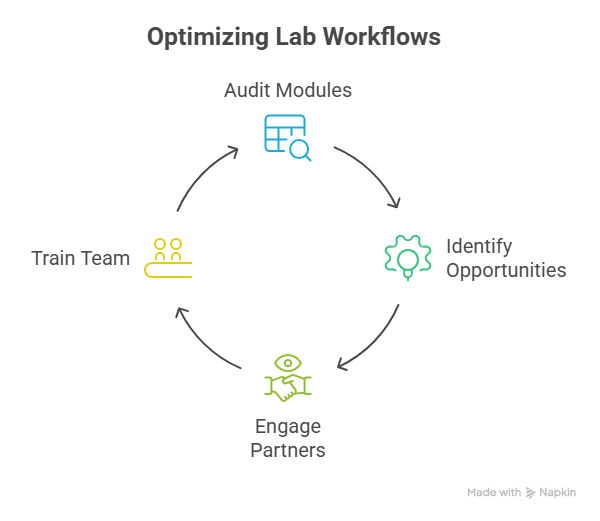
Start with this:
- Audit existing modules and map them to your lab’s daily workflows
- Identify underused features or missed automation opportunities
- Engage your vendor or implementation partner to unlock customizations
- Train your team continuously, not just once during setup
If you’re unsure where to start, begin with a system audit, talk to your team, identify gaps, and work with your vendor or IT team to make focused improvements.
Need help choosing or optimizing your LIMS? Get in touch with experts who understand both diagnostics and digital systems - and can tailor the solution to your lab’s needs.