Your report goes out. Your patient never comes back. And somewhere between that cold PDF and the next time they need a test, a competitor wins a customer you already paid to acquire.
This is the quiet crisis inside India's diagnostic sector-and it has nothing to do with your equipment, your turnaround time or your location. It starts, and often ends, with your patient-facing medical reporting strategy.
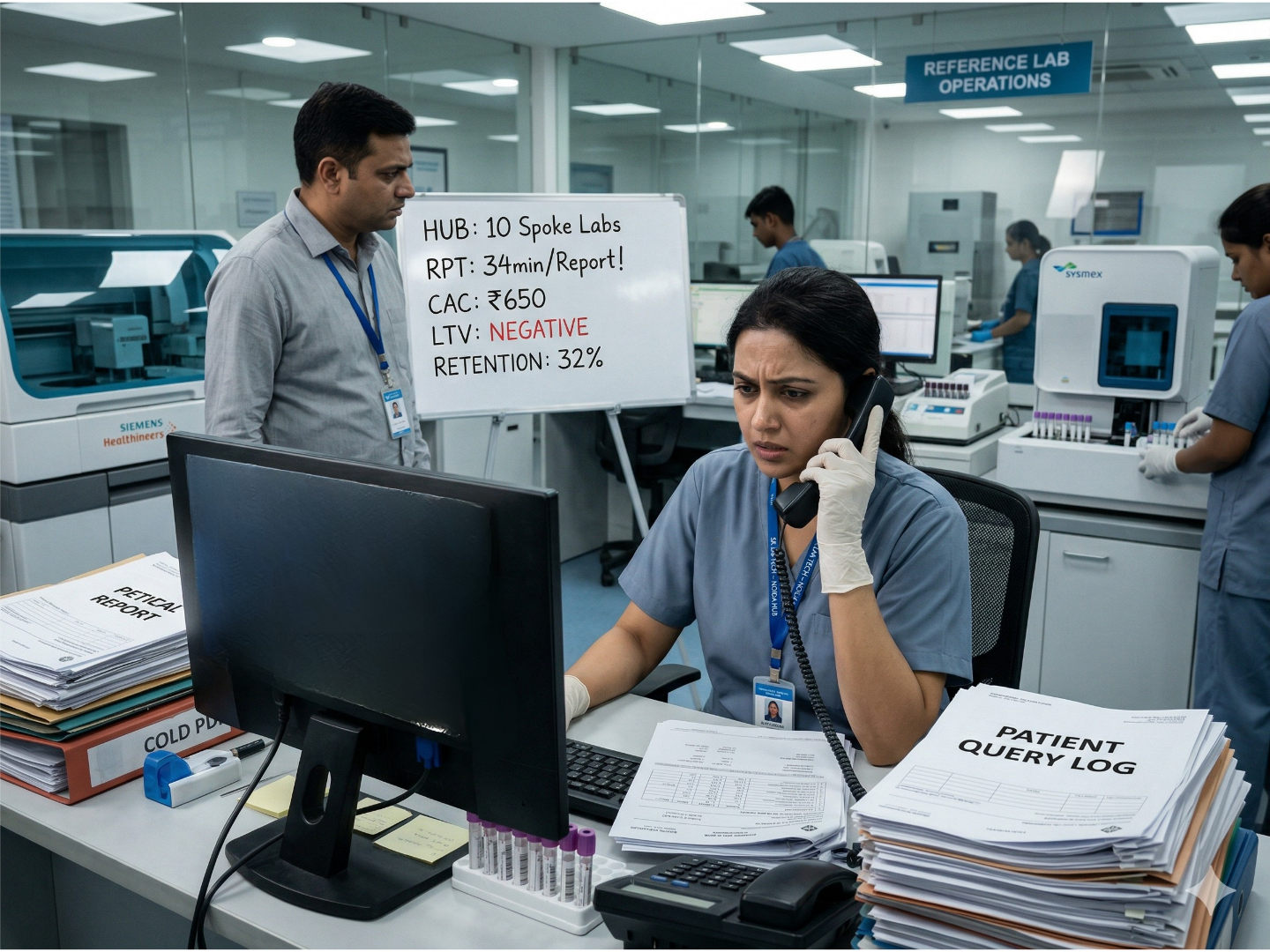
The Hub-and-Spoke Model’s Silent Killer: Operational Friction For the modern Indian diagnostic entrepreneur, the Hub-and-Spoke model was supposed to be the ultimate scale play. Centralize your high-complexity testing at a reference lab; expand collection touchpoints across the city; grow your revenue per square foot.
But as you add more collection centers, a silent killer emerges: Operational Friction.
Most lab owners realize too late that their Laboratory Information Management System (LIMS) is an excellent bookkeeping tool but a terrible growth tool. If your pathologists are still manually validating every borderline case, and your front desk is tethered to a phone explaining reports to confused patients, you are not scaling. You are compounding workflow inefficiency across every branch you open.
The problem is not your ambition. The problem is that your diagnostic output format hasn't kept pace with your operational expansion. In an era of "Instant Gratification," a patient shouldn't need a medical degree to understand their own blood work.
The ₹150 Retention Crisis: Why Your CAC Math Doesn't Add Up
Here is the number most lab owners don't track: the cost of acquiring a patient they never see again.
In Tier 1 and Tier 2 Indian cities, the Cost of Patient Acquisition (CAC) via digital marketing, local SEO, or doctor referrals now ranges between ₹400 and ₹700 per patient. If that patient receives a cold, clinical PDF and never returns, your ROI is negative from day one. To be profitable, you need a high LTV (Lifetime Value) per patient.
Consider what the data from the 2024 NirogGyan platform analysis tells us:
- 68% of Indian Patients choose their next diagnostic test based on the ease of understanding their previous report.
- Labs using traditional reporting formats spend an average of 22% more on support staff to handle "out-of-range" marker queries.
- The RPT Metric: There is a metric almost no lab measures called Report Perception Time (RPT)—how long a patient sits confused by their result before calling your front desk or, worse, before giving up and switching labs.
The real competitor is not the lab down the street. It is the patient's family WhatsApp group. When a family member receives a confusing report, the next test goes to whoever someone in that group recommends—not necessarily whoever ran the last test.
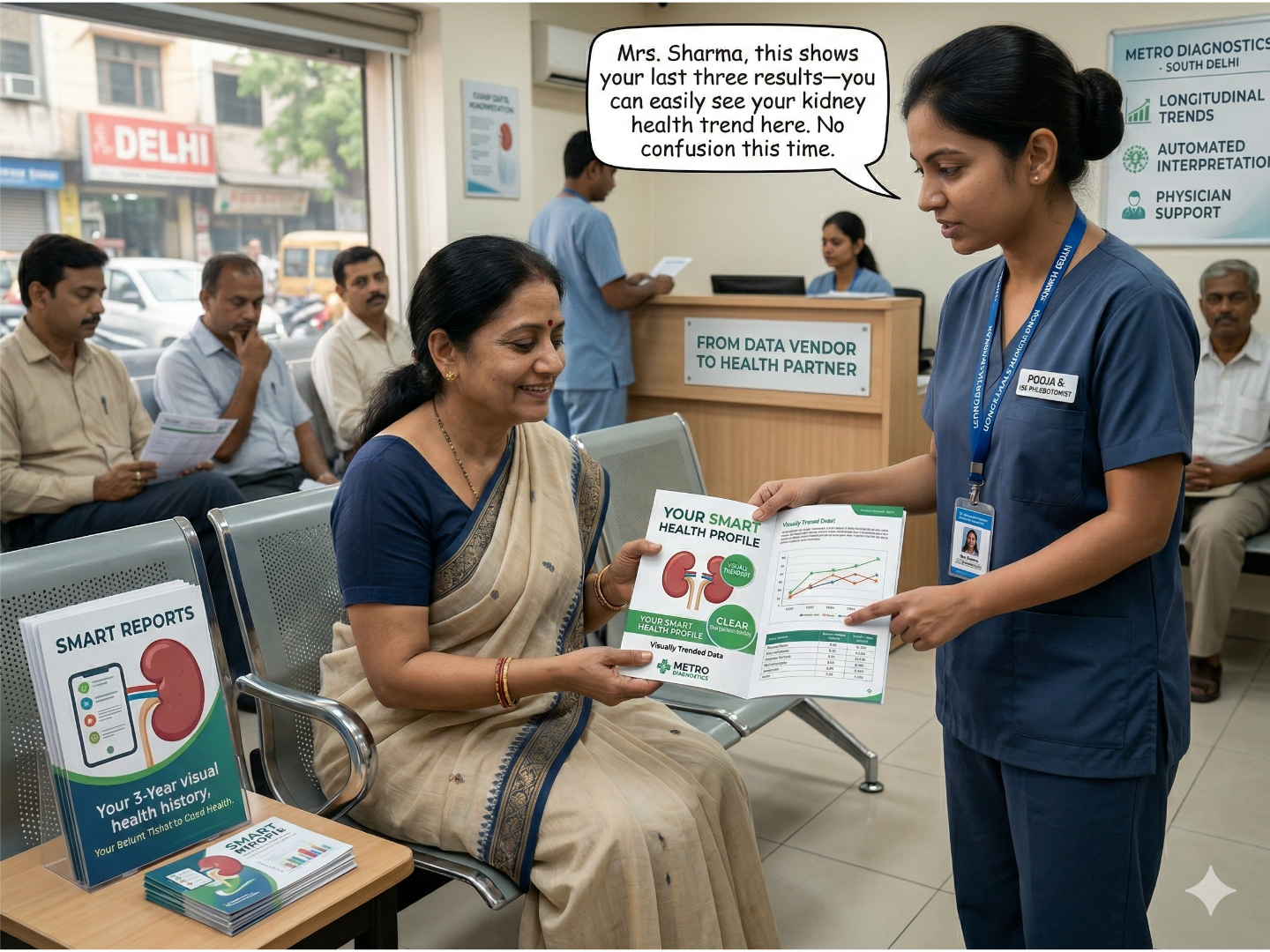
The Solution: Moving from "Data Vendor" to "Health Partner"
To protect your margins against price aggregators and appointment platforms, your lab must make one strategic shift: move from being a Vendor to a Health Partner. This requires upgrading your technical stack with a Clinical Interpretation Layer- a reporting intelligence system that sits between your LIMS output and your patient's screen.
1. Automated Clinical Correlation: Ending Interpretation Fatigue
Modern reporting software should not just list numbers; it should connect them. This is known as Automated Correlation. If a patient has elevated Creatinine, the report should automatically surface the Kidney Function Context—explaining what it means, why it matters, and which specific questions to ask their doctor.
By automating this "pre-interpretation," you achieve two things:
- Reduced Pathologist Burnout: Your overstretched doctors spend less time on routine explanations and more time on high-complexity cases.
- Reduced Support Overhead: A 47-branch diagnostic chain in Rajasthan reduced inbound patient query calls by 34% within 90 days of deploying NirogGyan Smart Reports.
2. Longitudinal Tracking: The "Data Moat" that Creates Lock-In
In the software world, "stickiness" is everything. In diagnostics, stickiness comes from Longitudinal Health Data. By offering patients a 3-year visual trend of their key health markers (HbA1c, Lipid Profile, TSH), you create a Data Moat that no competitor can replicate overnight.
A patient will stay with your lab because switching elsewhere means losing their entire organized health history. This is the diagnostic loyalty mechanic that turns a one-time walk-in into a lifelong client.
3. The Physician Value Add: Closing the Referral Loop
B2B success in diagnostics relies heavily on Doctor-Lab synergy. When a lab sends a "Smart Report," they aren't just helping the patient; they are providing Clinical Decision Support to the prescribing physician.
When a doctor receives a patient who already understands the basic implications of their Vitamin D deficiency or Lipid imbalance, the consultation becomes more efficient. The doctor spends less time explaining basic terminology and more time on the treatment plan. This creates a Physician Referral Loop—doctors prefer labs that make their job easier and their patients more compliant.
Middleware Interoperability: LIMS-Agnostic Scaling
Your reporting layer must work regardless of your underlying infrastructure. Whether your branches use Flabs, CrelioHealth, LiveHealth, or a custom-built LIS/HIS, your patient-facing output must be standardized.
Standardization is a brand decision. Your Bhopal collection center should produce a report that looks and feels identical to your Lucknow branch. Every inconsistency is a credibility gap. By using a LIMS-agnostic middleware, you ensure that as you acquire new labs or open new franchises, the Patient Experience (PX) remains premium and unified.
The Economics of RPP: Increasing Revenue Per Patient
Most lab owners focus on increasing the number of patients. The smarter play is increasing the Revenue Per Patient (RPP).
Smart reports facilitate this through "Insight-Driven Testing." When a report visually demonstrates a declining trend in a patient's kidney health or a borderline pre-diabetic HbA1c, the patient is psychologically more likely to book a follow-up test. You aren't "selling" them a test; you are providing the evidence-based reason for a follow-up. By moving your average patient from 1.2 tests per year to 2.5 tests per year, you effectively double your business valuation without spending an extra rupee on Facebook or Google ads.
Compliance as a Competitive Edge: NABL 131 and ISO 15189:2022
Beyond aesthetics, the "Smart Report" is a regulatory necessity. The NABL 131 guidelines and the ISO 15189:2022 update emphasize the importance of making reports "easy to interpret" for the end-user.
Most generic AI summary tools generate patient-facing text without clinical guardrails—creating massive medico-legal risk. NirogGyan’s proprietary clinical engine is built specifically to adhere to these standards:
- Clinically Grounded: Every explanation is reviewed against reference range context.
- DPDP Act Aligned: In 2026, Indian data privacy laws are non-negotiable. Our architecture ensures patient data remains secure and compliant with the latest Digital Personal Data Protection Act mandates.
For labs on a growth trajectory, this matters for two reasons: it removes accreditation audit risk, and it signals operational maturity to private equity investors evaluating your business for a potential exit.
Future-Proofing: The Shift to Structured Health Data
As we move further into 2026, the rise of AI Personal Health Coaches and wearable integration means patients will soon demand more than a flat PDF. They will want Structured Health Data-information that can be synced with their health apps.
Labs that stick to legacy PDF formats will be viewed as "The Nokia of Diagnostics." NirogGyan provides the bridge to this future, allowing your lab to offer API-ready, structured insights that integrate into the modern patient's digital ecosystem. This isn't just a report; it's a digital health asset.
The Advantage: Analytics Your LIMS Doesn't Provide
Most LIMS dashboards are designed for operations: how many samples were processed, how many are pending? Our dashboard is designed for the CEO and Marketing Head.
It provides real-time Patient Engagement Analytics, allowing you to see:
- Which patients actually need high priority intervention, before you lose them.
- Which health segments—Diabetes, Cardiac, or Vitamin Deficiencies—are your highest-volume growth drivers.
- Which collection centers are successfully converting first-time patients into repeat visitors.
These numbers inform where you open your next branch and which doctor referral partnerships are actually yielding a high ROI.
Conclusion: Is Your Report a Receipt or a Return Ticket?
Every report your lab sends out is either a One-Time Receipt or a Return Ticket.
A Receipt says: "Here is what we found, goodbye." A Return Ticket says: "Here is what we found, here is what it means for your future, here is your history with us, and here is why coming back to us is the safest choice for your health."
In the hyper-competitive Indian diagnostic market, you cannot afford to send receipts. Every cold PDF is a patient retention decision you are making by default-usually in favor of your competitor.
Ready to stop the churn and start scaling with intelligence?
For Labs & Hospital's owner : EXPLORE THE SMART WORLD OF REPORTING