Your Widal report shows numbers like 1:80 or 1:160 against O and H, and you are wondering whether that means typhoid. In India the answer is rarely a simple yes or no. This guide explains what the Widal test measures, how to read titres, why a single result can mislead, and what doctors usually do next.
Quick Summary
- What it is: The Widal test is a blood test that looks for antibodies against the bacteria that cause typhoid (enteric) fever, Salmonella Typhi and Paratyphi.
- What a titre means: It is the highest dilution of your blood serum that still shows a reaction. A larger second number, such as 1:160, means more antibody was present.
- The India problem: Typhoid is common in India, so many healthy people already carry some antibodies. There is no single universal cutoff. Labs and regions use different thresholds.
- A single result is weak evidence. Doctors look at your symptoms, a repeat test about 7 to 10 days later, and often a blood culture.
Want your whole report explained in plain English? Upload it to the NirogGyan Lab Report Analyzer for a clear, visual summary.
Confused by titres and antigen names on your Widal report? See your results in plain English.
Analyze my reportWhat Is the Widal Test and How Does It Work?
Doctors often order a Widal test when someone has a fever lasting more than four or five days along with tiredness, headache and abdominal discomfort. It is listed on lab reports as the Widal test.
It was developed by Fernand Widal in 1896 and works by agglutination, meaning clumping. The lab mixes your serum with killed Salmonella bacteria. If your blood contains antibodies against them, the bacteria clump together and the lab can see the reaction.
The test uses two main antigens:
| Antigen | Where it sits on the bacterium | What a high titre may suggest |
| O (somatic) | Cell body wall | Antibodies that rise early, so it is often linked to a current or recent infection |
| H (flagellar) | Flagella (tail-like structures) | Antibodies that appear later and can linger for months or years, so it can also reflect past infection or vaccination |
A full report usually has four lines: Salmonella Typhi O (TO), Salmonella Typhi H (TH), Salmonella Paratyphi A(H) and Salmonella Paratyphi B(H). Treat the O and H split as a rough guide only. It does not reliably separate a current infection from an old one.
Decoding Titres: What Do 1:20, 1:80 and 1:160 Mean?
To run the test, the lab dilutes your serum step by step with saline: 1:20, 1:40, 1:80, 1:160, 1:320 and so on. Your titre is the highest dilution at which clumping is still seen.
- 1:80 means the reaction was still visible when your serum was diluted 80 times.
- 1:160 means it was still visible at 160 times dilution, which means more antibody was present.
- 1:320 reflects more antibody again.
So the larger the second number, the higher the antibody level. A titre of 1:320 reflects far more antibody than 1:40.
The Indian Baseline Challenge: Why 1:80 Is Often Not Enough
Older textbooks, written for low-exposure populations, often treat a titre of 1:80 or even 1:40 as suggestive. In India this can lead to overdiagnosis.
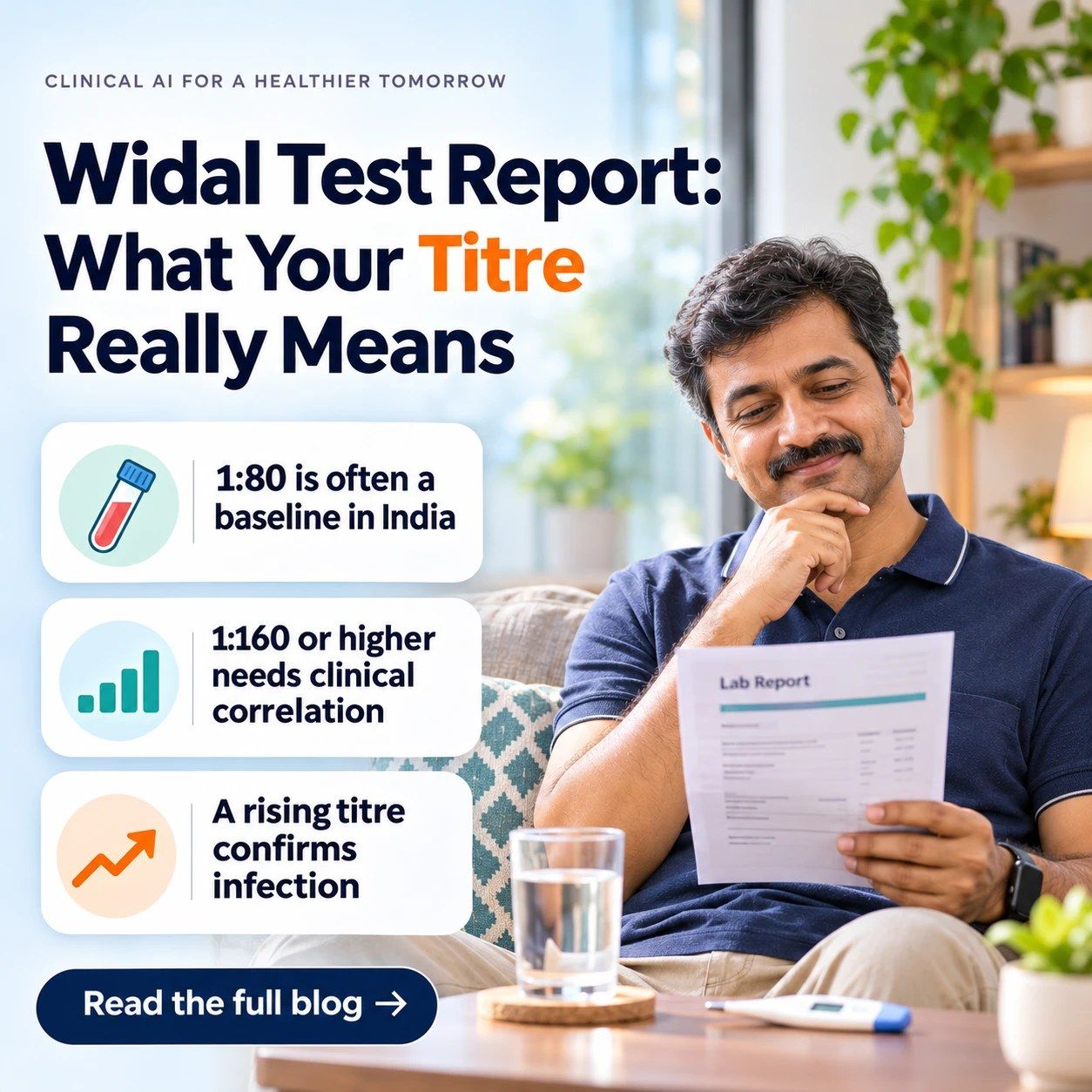
Because typhoid is common here, a notable share of healthy people have been exposed through food, water or past infection, and some have been vaccinated. That produces background antibodies. Many labs therefore use a higher cutoff, commonly 1:160 or above, but the right threshold varies between regions and labs.
- A single low or moderate titre (such as 1:80) is often non-specific and is commonly seen in people without active typhoid.
- A titre of 1:160 or higher, especially for the O antigen, makes doctors take it more seriously, but it still needs to match your symptoms and a repeat test.
Always read your titre against the local reference range your lab prints on the report, and let your doctor interpret it.
Why a Single Widal Test Can Mislead
Widal is known for false positives. A high titre does not automatically mean you have typhoid, because antibodies can rise for several other reasons:
- Past typhoid infection, even years ago
- Typhoid vaccination, which can raise H and O antibodies
- Other Salmonella infections and closely related bacteria that cross-react
- Other fevers, including malaria and dengue, where the immune system is generally activated
- Chronic liver disease and some autoimmune conditions, which can cause non-specific antibody rises
Because of this, infectious disease specialists treat a single, standalone Widal result as weak evidence.
The Rising Titre Concept
Antibodies take time to build. If you have active typhoid, blood drawn in the first week may show a low titre (for example 1:40), while blood drawn 7 to 10 days later may show a clear jump (for example 1:320). A fourfold or greater rise between two samples supports a current infection much better than one reading does.
Even a rising titre is interpreted alongside your symptoms and other tests, rather than on its own.
Modern Alternatives to the Widal Test
Antibody tests can be negative in the first week, because antibodies usually take 7 to 10 days from fever onset to appear. For that reason, doctors rely on other tests as well:
- Blood culture: Usually the preferred test in the first week of fever. It grows the bacteria from your blood and shows which antibiotics work. It can come back negative if antibiotics were already started, so ideally the blood sample is taken before the first dose.
- Rapid IgM tests such as Typhidot: Faster than Widal, but they also have accuracy limits and can stay positive after a past infection. See the Typhidot result explained.
- PCR tests: Detect bacterial DNA and can be accurate, but are costlier and available mainly at larger centres.
- Bone marrow culture: Very sensitive but rarely needed, usually reserved for difficult cases.
Have a Widal or fever panel report you are unsure about? Upload it to see everything in one clear view.
Analyze my reportSymptoms and Warning Signs of Typhoid
Typhoid typically causes a step-wise rising fever over several days, with tiredness, headache, loss of appetite, stomach discomfort and either constipation or loose stools. Some people develop a rash of small pink spots.
Go to a doctor or hospital promptly if you have:
- Fever lasting more than 3 to 5 days
- Severe or worsening abdominal pain
- Persistent vomiting or inability to drink fluids
- Confusion, extreme drowsiness or a very high fever
- Blood in the stool or black stools
These can signal complications and need urgent care. Do not wait for a repeat Widal test.
Prevention: Safe Water, Food and Vaccination
- Drink boiled or properly filtered water and avoid ice of unknown source
- Eat freshly cooked food, and be careful with street food and raw salads when hygiene is uncertain
- Wash hands with soap before eating and after using the toilet
- Ask your doctor about the typhoid conjugate vaccine, which is recommended in many areas of India, especially for children
This guide is for general understanding and is not a diagnosis. Please discuss your report with a qualified doctor. To read other parts of your fever workup, see our guides on the DLC white cell count and how to read a medical lab report.
Frequently Asked Questions
Is a Widal titre of 1:80 positive for typhoid in India?
In many parts of India a titre of 1:80 is treated as a possible background level rather than proof of active infection. A titre of 1:160 or higher, together with your symptoms and ideally a repeat test after 7 to 10 days, is usually needed before doctors suspect enteric fever. Cutoffs vary by lab and region, so follow your doctor's interpretation.
What is the difference between O and H antigens on a Widal report?
The O (somatic) antigen is on the bacterial cell body, and antibodies to it tend to rise early and fall sooner. The H (flagellar) antigen is on the flagella, and antibodies to it tend to appear later and can last for months or years, including after vaccination. This is a rough guide only.
Can a typhoid vaccine make my Widal test positive?
Yes. Vaccination can raise antibodies and give a raised titre even when you are well. Tell your doctor and the lab about any recent typhoid vaccination.
Why do doctors order a blood culture instead of only a Widal test?
In the first week of fever, antibodies may not have built up yet, so Widal can be falsely low. A blood culture grows the bacteria directly and shows which antibiotics will work. For best results, the blood sample should be taken before antibiotics are started.
Should I start antibiotics if my Widal shows 1:160?
No. Do not start antibiotics on your own based on a Widal report. A high titre can come from a past infection, vaccination or another tropical fever, and unnecessary antibiotics add to antibiotic resistance. A doctor should decide after examining you and reviewing your tests.
Turning Report Confusion Into Clarity
A Widal report full of ratios and antigen codes can cause needless anxiety. Remember that antibody tests reflect immune memory as well as active disease, especially where exposure to typhoid is common. Your symptoms, a repeat test and, where possible, a blood culture give a much clearer picture.
Ready to understand your complete diagnostic report in seconds? Upload your lab PDF for a private, plain-English breakdown.
Analyze my report