Last updated: September 2026 · 5 min read
Quick answer: Yes, ChatGPT can explain a lab report you upload. It's good at telling you what a test measures. But it's a general-purpose assistant. It reads whatever you give it, doesn't follow a fixed clinical framework, and research on earlier chatbot versions found they overstated how serious results were far more often than doctors did. For a clear, guideline-based explanation of every value, use a Smart Report built for lab reports. Labs can send one with every report, under their own brand.
Everyone's asking ChatGPT about their reports
OpenAI says more than 300 million people ask ChatGPT health questions every week. In January 2026 it launched ChatGPT Health, a separate space for health questions. In July 2026 it let US users connect their medical records.
In India and the GCC, it usually goes like this. Your report lands on WhatsApp as a PDF at 10 pm. You don't want to wait for the doctor. So you paste it into ChatGPT and read the answer before anyone qualified has seen your results.
That's understandable. But it's worth knowing what you're getting.
What ChatGPT does well
Let's be fair. ChatGPT is genuinely useful for some of this.
- It explains what a test measures in plain language.
- It answers follow-up questions in a natural conversation.
- It helps you prepare questions before a doctor's visit.
- It's available anytime, in many languages.
OpenAI itself says ChatGPT Health isn't meant for diagnosis or treatment. It's a general assistant that happens to be good at explaining things. Reading a lab report is a narrower, harder job.
Where ChatGPT falls short on lab reports
1. It's only as good as what you upload
A lab report is a dense table. It has values, units, reference ranges, flags and footnotes, often across several pages. A blurry phone photo or a scanned PDF can shift a column or drop a unit.
If ChatGPT reads one value wrong, everything it says about that value is wrong too. Nothing warns you when that happens.
2. Ask twice, get different answers
ChatGPT doesn't follow a fixed clinical framework. Change how you word the question and you can get a different emphasis, a different level of concern or a different next step.
A Smart Report works differently. Every value goes through the same library, every time. NirogGyan's covers 1,250+ parameters across 42 test profiles. Each range is based on published guidelines from Mayo Clinic, CAP, CLSI, IFCC, ADA, KDIGO, WHO and ACC/AHA.
3. It can make results sound scarier than they are
A 2025 review of AI in laboratory medicine found that chatbots overstated how serious a clinical finding was in 22% to 33% of cases. For doctors, the rate was 1%. Those studies tested earlier chatbot versions, and newer models have improved. But the pattern matters, because a scary sentence at 11 pm doesn't come with a follow-up call.
A good explanation does the opposite. It shows what's normal, what's slightly off and what actually needs a doctor, in that order. Don't panic, just scan.
4. It doesn't know what happens next
ChatGPT sees your numbers. It doesn't know your lab's test packages, when you're due for a repeat test, or which doctor ordered the test.
A Smart Report from your lab comes with the full picture:
- A summary for your doctor, as text or AI video
- Charts that show where each value sits
- Next steps tied to your results
5. Your report is a medical record
Before you upload, think about where your data goes. OpenAI says conversations in ChatGPT Health aren't used to train its models. Check which space you're using, and what your settings are.
When your lab sends a Smart Report, your data stays under your lab's agreement with NirogGyan. It's HIPAA compliant and encrypted end to end.
What about Gemini, Claude and Copilot?
ChatGPT isn't the only chatbot people trust with their reports anymore. By May 2026, Google's Gemini had grown to about 27% of all visits to AI chatbot websites, up from under 9% a year earlier. Claude and Copilot are growing too.
Everything on this page applies to all of them. They're general-purpose assistants. They're good at explaining what a test measures. But they read whatever you upload, they don't follow a fixed clinical framework, and each one words the same result differently.
Try it yourself. Paste the same report into 2 different chatbots and compare the answers. You'll often get a different emphasis, a different level of concern and a different next step.
A Smart Report gives you the same guideline-based explanation every time, whichever device you open it on.
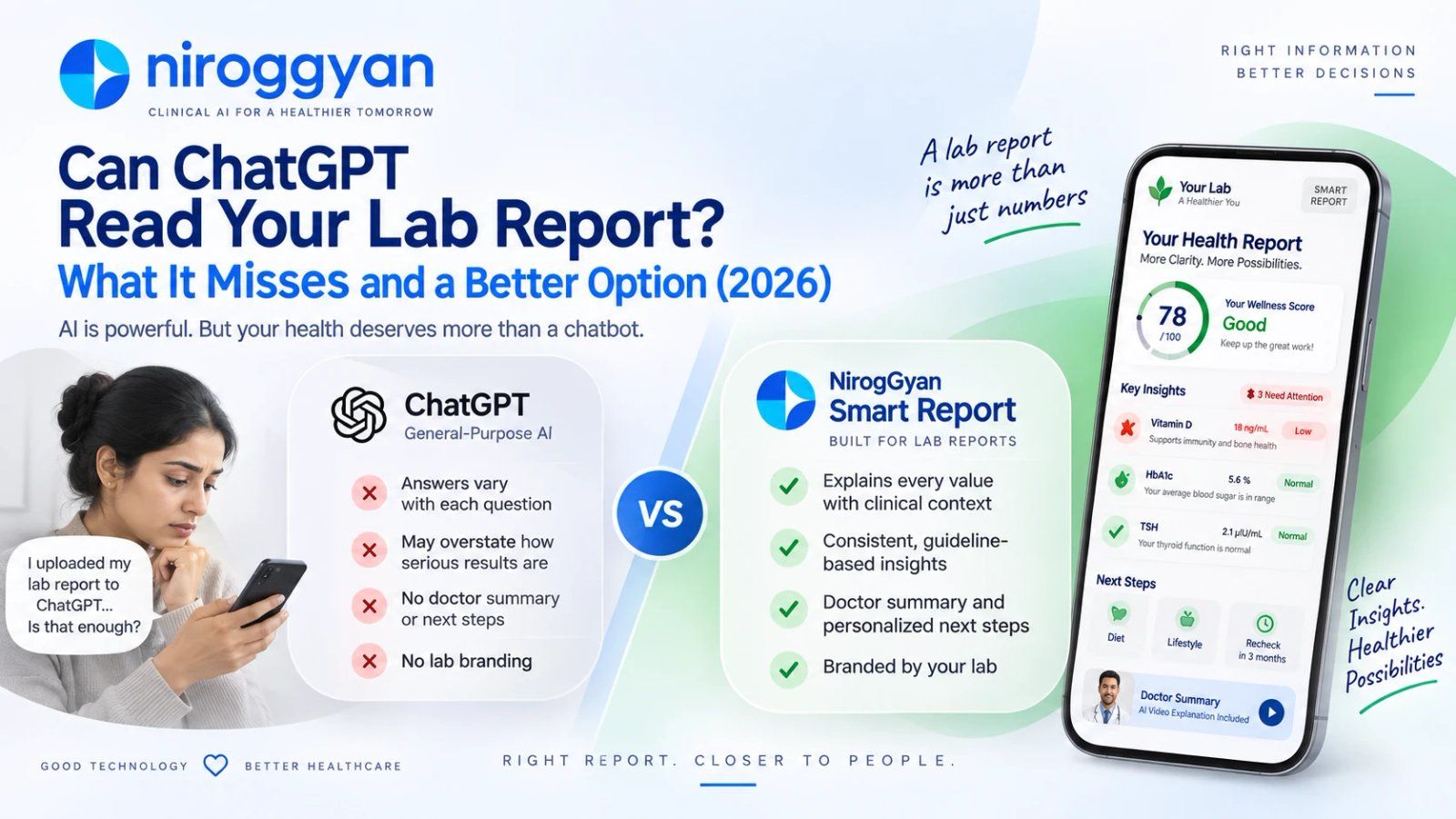
ChatGPT vs a Smart Report at a glance
| Feature | ChatGPT | NirogGyan Smart Report |
| What it is | General-purpose AI assistant | Built for lab reports |
| Test coverage | Whatever you upload | 1,250+ parameters, 42 profiles |
| Consistency | Varies with how you ask | Same guideline-based library every time |
| Tone | Depends on the question | Calm, highlights what matters most |
| Format | Chat conversation | PDF and web app with charts |
| How you get it | You upload it yourself | Arrives with your report |
| Doctor summary | Only if you ask | Built in, as text or AI video |
| Your lab's branding | No | Yes |
For labs: your patients are already doing this
Every report you send is a PDF. And more and more, someone else explains it.
When a patient pastes your report into ChatGPT, you lose 4 things:
- The brand moment. The most-read document you produce gets explained without your name on it.
- Control. You don't know what your patient was told, or how.
- The follow-up. Nobody points the patient back to you for a repeat test.
- Your front desk's time. Worried patients call. Confused ones call again.
Smart Reports close that gap. The explanation arrives with the report, under your brand, on PDF, web and SMS. Across NirogGyan labs, 70%+ of patients engage with their Smart Report, and they spend 3 to 5 minutes on it on average. Labs also see 65% fewer follow-up queries.
It connects to your existing LIS, or works without one. See how on our LIS Integrations page.
When ChatGPT is the right tool
ChatGPT still has a place. Use it to:
- Learn what a test is before you book it
- Ask follow-up questions after you've read your Smart Report
- Explore general diet and lifestyle questions
The best approach combines both. Read your results in a Smart Report first. Then take your questions to ChatGPT, or better, to your doctor.
How to get a Smart Report
- Your lab offers Smart Reports: it comes with your report automatically.
- Your lab doesn't: upload your report to NirogGyan's Lab Report Analyzer.
- You run a lab: book a demo and see your own report as a Smart Report.
FAQs
Can ChatGPT read blood test results?
Yes. You can upload a lab report and ChatGPT will explain it. How good the answer is depends on how clearly it reads the file and how you word your question. It doesn't follow a fixed clinical framework.
Is ChatGPT accurate for lab reports?
It's good at explaining what tests measure. Research on earlier chatbot versions found they overstated how serious results were in 22% to 33% of cases, compared with 1% for doctors. Always check results with a doctor.
Is it safe to upload my lab report to ChatGPT?
OpenAI says conversations in ChatGPT Health aren't used to train its models. Your report is still a medical record, so check which space you're using and your privacy settings before you upload.
What is ChatGPT Health?
ChatGPT Health is OpenAI's dedicated space for health questions, launched in January 2026. In July 2026, it let US users connect medical records and Apple Health. OpenAI says it isn't meant for diagnosis or treatment.
Can Gemini read my lab report?
Yes. Like ChatGPT, Gemini can explain a lab report you upload. It has the same limits: it depends on how clearly it reads your file and how you phrase your question. For a consistent explanation of every value, use a Smart Report.
Which AI is best for reading lab reports?
General chatbots like ChatGPT, Gemini and Claude are good for learning what a test means. For your actual results, a tool built for lab reports is more reliable. It uses fixed, guideline-based ranges and highlights what matters first. Ask your lab for a Smart Report, or use NirogGyan's Lab Report Analyzer.
What's better than ChatGPT for understanding a lab report?
A Smart Report built for lab results. It explains every value using guideline-based ranges, shows what matters most first, and includes a summary for your doctor. Ask your lab for one, or use NirogGyan's Lab Report Analyzer.
ChatGPT is a trademark of OpenAI. NirogGyan isn't affiliated with OpenAI. This article is for information only and isn't medical advice. Always discuss your results with a doctor. Sources checked September 2026.