Last updated: September 2026 · 5 min read
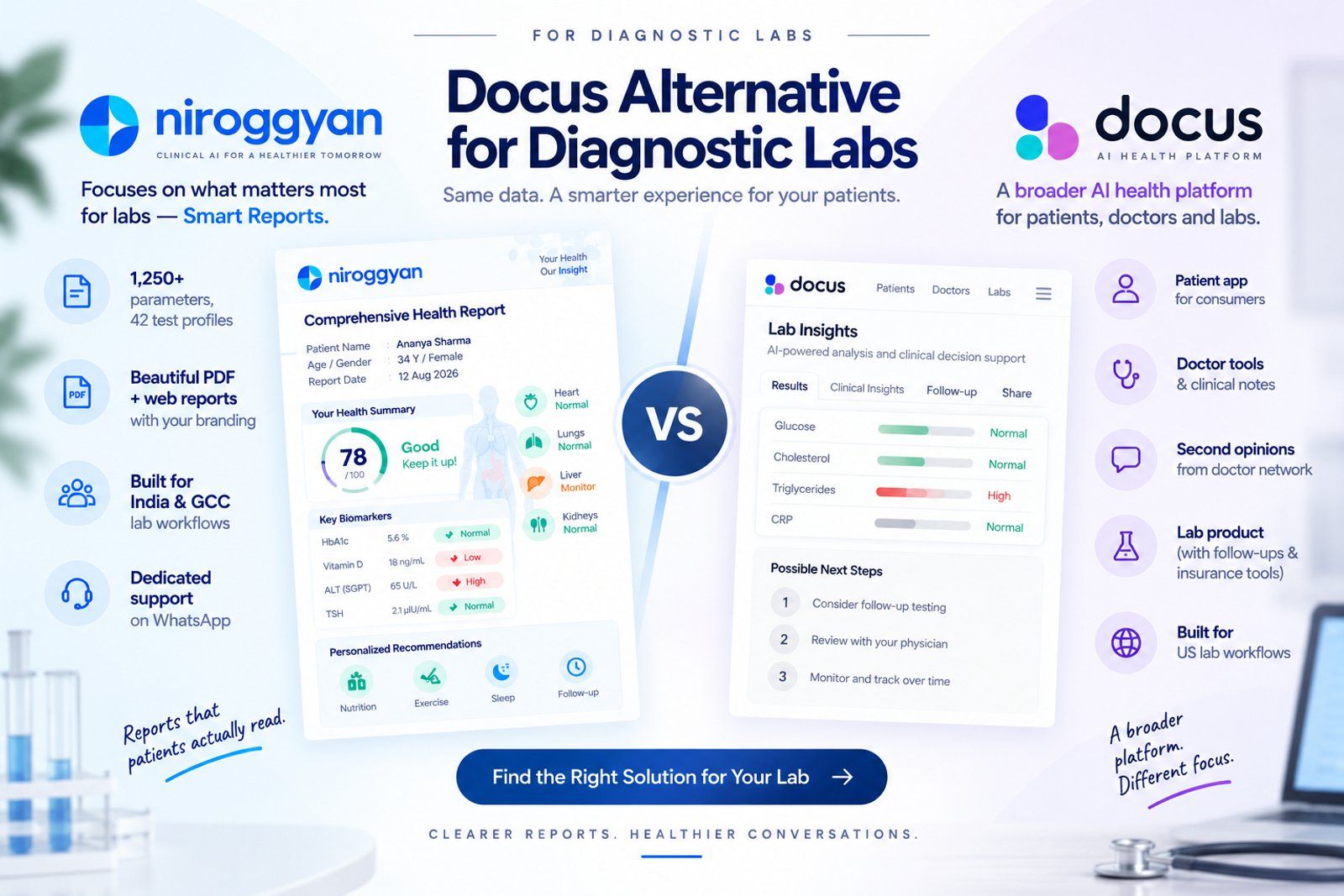
Quick answer: NirogGyan is a Docus alternative for labs and hospitals in India and the GCC that want patient-friendly Smart Reports, without a wider platform built around US lab workflows. Docus is a broad AI health platform: a patient app, doctor tools, paid second opinions and, since 2025, a lab product with follow-up and insurance compliance tools. NirogGyan has done one thing since 2019: Smart Reports for labs, in PDF and on the web, with dedicated support. Choose Docus for US workflows and specialty testing. Choose NirogGyan for focused Smart Reports built for your region.
Why labs compare Docus and NirogGyan
Docus is a serious player. Its lab product plugs into LigoLab, a US lab information system, which gives it access to LigoLab's partner labs across the US. It publishes strong case studies too.
But Docus is a platform with many products:
- An AI doctor app for consumers
- A doctor platform with clinical notes and patient messaging
- Paid second opinions from its doctor network
- Lab software and an API
So the real question for your lab is simple. Do you need a platform, or do you need Smart Reports done really well?
NirogGyan vs Docus at a glance
| Feature | NirogGyan | Docus |
| Lab reporting since | 2019 | 2025 (Docus for Labs) |
| Core focus | Smart Reports for labs and hospitals | Patients, doctors, labs, API, second opinions |
| Built around | India and GCC lab workflows | US lab workflows, incl. ICD and medical-necessity checks |
| Test coverage | 1,250+ parameters, 42 profiles | Routine and specialty, incl. microbiology, toxicology, PGx |
| Report formats | PDF, web app, mobile, SMS | Docus web interfaces, plus API into your LIS or EHR |
| Doctor output | Summary of key findings, as text or AI video | Clinical decision support, incl. possible diagnoses |
| Next steps | Actionable next steps per result | Follow-up test suggestions + patient reminders |
| Integration | HL7 v2.x, HL7 FHIR R4, REST, SFTP, manual upload | API/HL7, manual entry, PDF upload |
| Pricing | Pay-as-you-go by report volume, no setup fee | Custom quote by test volume, complexity, region |
| Compliance | HIPAA, SOC 2 Type II | HIPAA, GDPR, SOC 2 |
| Support | Dedicated team, on WhatsApp, Indian hours | Sales contact |
1. A specialist, not a platform
Docus sells to 4 audiences: patients, doctors, labs and developers. Every product competes for its team's attention.
NirogGyan sells one thing: Smart Reports for labs. We've built them since 2019. Every release, every template and every hour of support goes into making your report clearer for your patients.
When you call us about a report, you reach people who work on reports all day.
2. Built for how Indian and GCC labs work
A lot of Docus's lab stack exists for the US system. It checks ordered tests against diagnosis codes, drafts medical-necessity statements and helps prevent insurance claim denials. Its biggest distribution deal is with a US lab information system.
That's valuable in the US. In India, where most patients pay for tests themselves, it's machinery your lab won't use.
NirogGyan is built for how your lab actually works:
- Health packages with 60 to 100+ parameters
- Reports that travel on WhatsApp
- Patients who read in more than one language
- Multi-branch labs and hospital networks
It's why labs like Dr Dangs, PharmEasy-Thyrocare and Zaincare in Oman use Smart Reports.
3. A PDF your patients will actually read
Docus delivers through its own web interfaces for labs, doctors and patients, or pushes reports into your LIS or EHR through its API.
That works if your patients log into portals. In India and the GCC, most don't. They open the PDF you send on WhatsApp.
So NirogGyan treats the PDF as a product, not an export:
- Multiple templates by specialty
- Your branding throughout
- Charts and plain-language explanations right on the page
The same report also opens as a web app, with SMS links and a mobile view. Your patients get the full experience whichever way they open it.
4. Explain the result. Leave the diagnosis to the doctor.
Docus positions itself as clinical decision support. Its doctor reports include possible diagnoses, follow-up suggestions and a clinical plan.
Some labs want that. Many don't. A lab report that suggests diagnoses can blur the line between your lab and the treating doctor.
NirogGyan keeps the report on your side of that line:
- Patients get clear explanations and next steps.
- Doctors get a summary that highlights abnormal values and trends, as text or AI video.
- The diagnosis stays with the doctor.
5. Support from a team that knows your lab
Every NirogGyan lab gets dedicated customer support, on WhatsApp, in Indian hours that overlap the GCC workday. The same team runs your integration, trains your staff and stays with you after go-live.
The results show up in how patients use their reports. Across NirogGyan labs, 70%+ of patients engage with their Smart Report, spending 3 to 5 minutes on it on average, and labs see 65% fewer follow-up queries.
How each one connects to your LIS
Both can run with or without an integration.
NirogGyan supports:
- HL7 v2.x for legacy systems
- HL7 FHIR R4
- REST APIs
- Real-time webhooks
- SFTP batch transfers
You test everything in a sandbox first. Most labs go live in 2 to 4 weeks.
Docus integrates through API or HL7. Labs can also enter results by hand, upload structured PDFs, or use Docus's own interfaces with no integration at all.
When Docus might be the better fit
We'd rather you choose the right tool. Docus may suit you better if:
- You're a US lab, especially one running LigoLab. Docus is already integrated there.
- You need insurance-side tools, like ICD validation, medical-necessity statements and digital requisitions.
- Your menu is heavy on specialty testing, like toxicology, pharmacogenomics or microbiology.
- You want automated follow-up test suggestions and patient reminders out of the box. Docus reports that at Blood Cells Laboratories, the follow-up testing rate rose from 5% to 27%.
Looking to understand your own report, not run a lab? Try NirogGyan's Lab Report Analyzer.
Switching from Docus to NirogGyan
- Share your test menu and a few sample reports.
- We map every parameter to our library and flag anything new.
- You pick a template and set your branding.
- We connect your LIS, or set up upload, in our sandbox.
- You run a pilot on real patients, then go live.
FAQs
What's the best Docus alternative for diagnostic labs?
For labs and hospitals in India and the GCC, NirogGyan is a strong option. It's focused only on Smart Reports for labs, covers 1,250+ parameters across 42 profiles, delivers PDF and web reports, and includes dedicated support.
What is Docus for Labs?
Docus for Labs is Docus's lab product, launched in 2025. It creates AI interpretation reports for doctors and patients, suggests follow-up tests and connects through API or HL7.
How much does Docus cost for labs?
Docus doesn't publish lab pricing. It quotes based on test volume, workflow complexity and region. NirogGyan charges by monthly report volume, with no setup fee.
Does NirogGyan suggest diagnoses?
No. NirogGyan explains results for patients and highlights abnormal values and trends for doctors. Diagnosis stays with the treating doctor.
Can NirogGyan work without an LIS?
Yes. Labs without a modern LIS can upload reports manually or use a basic API connection.
Book a demo or email your test menu to sales@niroggyan.com, and we'll show you how many parameters we cover.
Book a DemoDocus details come from docus.ai, Docus press releases and public listings, checked September 2026. Pricing and features may change. Docus is a trademark of its owner. NirogGyan isn't affiliated with Docus.