What is a lab report analyzer? And why everyone over 30 should use one
A lab report analyzer explains every value in your blood test in plain language. It tells you what each test measures, whether your result is normal, and what to ask your doctor.
Why regular blood tests matter in India
Many long-term diseases in India cause no symptoms for years.
- adults has diabetes
- 1 in 9
- about 10.1 crore people
- has prediabetes
- 1 in 7
- about 13.6 crore people
- has high blood pressure
- 1 in 3
- about 31.5 crore people
- have abnormal cholesterol
- 8 in 10
- 81.2% of adults
Source: ICMR-INDIAB study, The Lancet Diabetes & Endocrinology (2023)
Diabetes, high blood pressure and high cholesterol do not hurt. Many people find out only after a heart attack, a stroke or kidney damage.
Simple tests can catch them years earlier: fasting glucose, HbA1c, a lipid profile and a blood pressure check. Found early, they are easy and cheap to manage.
A full-body checkup at a major Indian lab usually costs ₹1,500 to ₹4,000. Finding a disease late costs far more.
Who should test, and how often
| Age 20–30, no family history | Basic tests every 2–3 years: CBC, lipid, thyroid, liver, kidney, vitamin D, B12 |
|---|---|
| Age 30–50 | The same tests every year, plus fasting glucose and HbA1c |
| Age 50 and above | Every year, plus tests your doctor adds |
| Family history of diabetes, heart or thyroid disease | Glucose and lipid tests every 6 months |
| Already have a long-term condition | Follow your doctor's schedule |
General guidance for adults who feel well. Always follow your doctor's advice.
Why read your report before you see the doctor
Not to replace your doctor, but to get more from your visit.
A checkup can have 40 to 80 values. In a short visit, your doctor explains the two or three that matter most. Reading your report first helps in three ways.
You ask better questions
“My LDL is 142. Is that safe for me?” gets a clearer answer than “Is my cholesterol fine?”
You notice small signals
Like a slightly high TSH that needs a recheck, or low ferritin that explains your tiredness.
You remember the advice
You already know the words, so the doctor's advice is easier to follow.
Think of the analyzer as a translator between the lab and your doctor.
What a lab report analyzer does
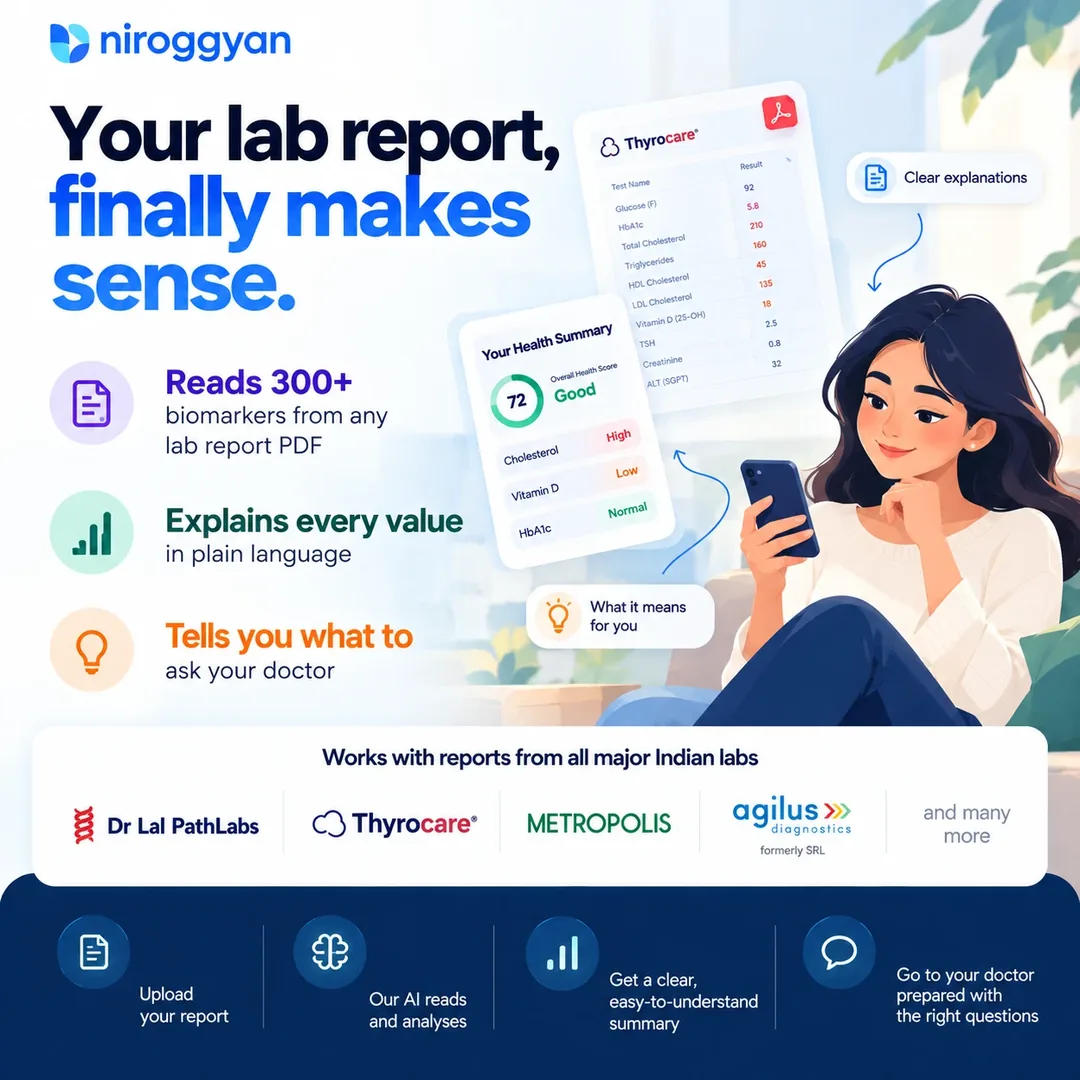
Upload a PDF or a clear photo of your report. The analyzer reads every value and compares it with the normal range for your age and sex. Then it tells you:
- What each test measures
- Whether your value is normal, borderline or out of range
- What a high or low value can mean, and what it does not
- What to ask your doctor about any flagged value
Works with reports from any Indian lab
Including these labs, each with its own guide:
- Dr Lal PathLabs
- Thyrocare
- Metropolis Healthcare
- SRL / Agilus Diagnostics
- Apollo Diagnostics
- Redcliffe Labs
- Healthians
- Tata 1mg Labs
- Neuberg Diagnostics
- Vijaya Diagnostic
Covers every routine checkup panel
Tap a panel to learn about its main test.
When not to wait: see a doctor the same day
The analyzer is not for emergencies. If any of these apply, call your doctor or go to a hospital the same day.
Results that need urgent review
- Haemoglobin below 7 g/dL
- Fasting glucose above 300 mg/dL, or random glucose above 400 mg/dL
- Creatinine doubled since your last report, or eGFR below 30
- SGPT (ALT) or SGOT (AST) more than 5 times the normal limit
- Platelets below 50,000 /µL
- Potassium below 3.0 or above 6.0 mmol/L
- Any value your lab marks as critical
General limits only. Your doctor's advice comes first.
Symptoms that need urgent care
- Chest pain, breathlessness, sudden weakness on one side or slurred speech
- Severe or sudden stomach pain
- Confusion, fainting or a seizure
- Heavy or unexplained bleeding
- Fever above 103°F (39.4°C) that does not come down
How to use the Lab Report Analyzer
Get your report
Download the PDF from your lab's app, website, SMS or email.
Upload it
PDF, JPG or PNG up to 15 MB. Multi-page reports work too.
We read your details
Your age and sex are taken from the report to pick the right normal ranges.
See your free summary
How many values are normal, borderline or out of range, by body system.
Get every value explained
Unlock the full Smart Report, with questions to ask your doctor.
Upload your report
Your health summary is free. Privacy policy
Your report is sent over secure, encrypted connections. We do not sell your information. To see, correct or delete your data, write to contact@niroggyan.com.
Frequently asked questions
Is the Lab Report Analyzer free?
Uploading your report and seeing your health summary is free. The full Smart Report, with every value explained, is a paid upgrade. You see the price before you pay.
Does this replace my doctor?
No. It helps you understand your report and prepare for your visit. Only a doctor can diagnose or treat you.
Is my report safe and private?
Your report is sent over secure, encrypted connections. We do not sell your information. To see, correct or delete it, write to contact@niroggyan.com.
Which labs' reports does it work with?
Reports from any Indian lab, including Dr Lal PathLabs, Thyrocare, Metropolis, Agilus (formerly SRL), Apollo, Redcliffe, Healthians, Tata 1mg, Neuberg and Vijaya.
What if my report is a blurry photo?
Upload the PDF from your lab, or a clear, well-lit photo of each page. Values that cannot be read may be missed.
Can the analyzer be wrong?
It can misread a poor scan or an unusual layout. Always check important values with your original report and your doctor.
How often should I get a blood test?
Once a year is a good baseline if you are over 30 and feel well. Test more often if you have a long-term condition, a family history, or are over 50.
Is this guide available in other languages?
Yes. It is available in Hindi, Tamil, Telugu, Bengali, Marathi, Gujarati, Kannada, Malayalam, Punjabi and Odia. Use the language links at the top of the page.
Your lab report, finally makes sense
Upload it and see your free health summary in about a minute.
This page and the Lab Report Analyzer are for general health information only. They do not give a diagnosis, treatment or medical advice. Always consult a qualified doctor. Lab names are trademarks of their owners.