When a patient recovers from a difficult illness, they usually thank the physician who prescribed the treatment or the surgeon who performed the procedure.
Almost nobody walks into the laboratory to thank the doctor who spent hours examining a slide under a microscope, cross-checking results, or validating an unexpected analyser reading.
Yet among clinicians, pathologists are often called the "doctor's doctor".
International Pathology Day, observed on the second Wednesday of November (11 November in 2026), is a good moment to step back and look at how clinical clarity is actually created, and why the people working behind the scenes deserve far more recognition.
Why Laboratory Results Matter So Much
A widely quoted figure says laboratory results influence around 60 to 70% of clinical decisions. The exact share is debated, because the original claim was never backed by a traceable study, but the principle is hard to argue with. Laboratory results help decide whether a fever needs antibiotics, whether a lump is a tumour, and how a critically ill patient is responding to treatment.
The Rock, Paper, Scissors of Healthcare
We came across a visual analogy that explains the diagnostic journey through a familiar game: Rock, Paper, Scissors. In the game, each choice beats the next. In medicine, the three elements do not compete. They work in sequence, each playing a critical role in moving a patient from uncertainty to answers.
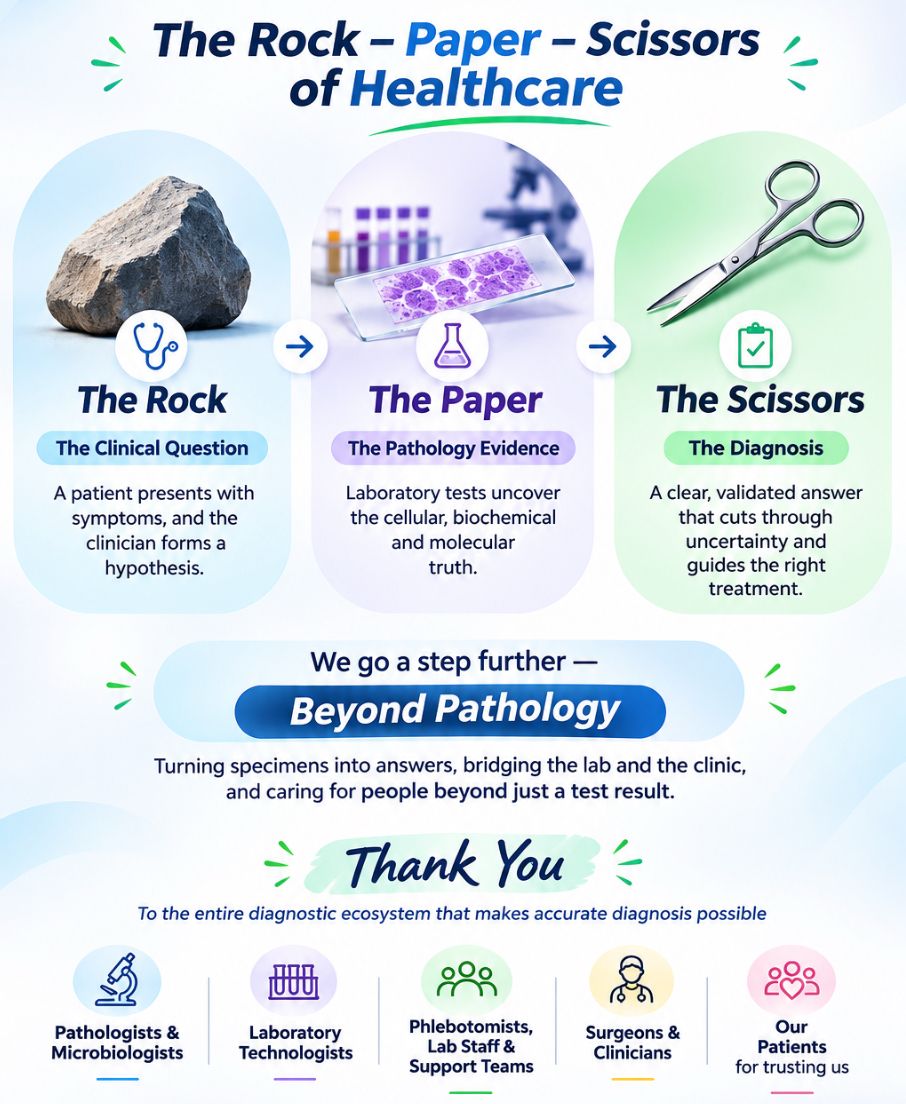
| Step | What it represents | What happens |
| The Rock | The clinical question | A patient presents with symptoms and the clinician forms a hypothesis |
| The Paper | The pathology evidence | Laboratory tests uncover the cellular, biochemical and molecular facts |
| The Scissors | The diagnosis | A clear, validated answer cuts through uncertainty and guides treatment |
1. The Rock: The Clinical Question
Every medical journey begins with a problem that needs solving. A patient walks into a clinic with unexplained fatigue, a persistent fever, a suspicious lump or chest pain. The clinician draws on medical history, physical examination and experience to form a hypothesis.
But human biology is rarely straightforward, and different diseases can produce remarkably similar symptoms. Without reliable diagnostic evidence, even the most experienced clinician is left working with possibilities rather than answers. That is the Rock: the clinical question that needs to be addressed.
2. The Paper: The Pathology Evidence
Just as paper covers rock, pathology evidence addresses the clinical question by uncovering what is happening beneath the surface. Whether it is a blood sample, a urine specimen or a stained histopathology slide, the laboratory extracts the cellular, biochemical and molecular evidence needed to support clinical decisions.
Behind that seemingly simple report is a chain of precision:
- Pre-analytical integrity: Phlebotomists and laboratory support teams make sure the right sample is collected, correctly labelled, stored and transported.
- Analytical rigour: Laboratory technologists run quality controls, calibrate analysers, manage sensitive reagents and make sure test results are accurate.
- Clinical validation: Pathologists investigate unexpected findings, tell genuine abnormalities apart from testing artefacts, and spot subtle changes in cell appearance that automated systems may miss.
Consider a low platelet count that is actually caused by harmless EDTA-induced platelet clumping, or subtle changes on a peripheral blood smear that an analyser overlooks. These are not just technical details. They can change the course of a patient's diagnosis and treatment. If you want to see how a blood smear feeds into a report, read our guide on the DLC test.
3. The Scissors: The Diagnosis That Cuts Through Uncertainty
When the clinical question (the Rock) meets verified pathology evidence (the Paper), the result is a diagnosis that cuts through uncertainty.
For patients, anxiety does not come only from being unwell. It also comes from not knowing what is wrong. A reliable diagnosis helps clinicians move beyond guesswork and trial-and-error treatment. It can prevent unnecessary medication, guide further investigation and give a clearer direction for surgical or therapeutic intervention.
This is where the diagnostic ecosystem delivers its greatest value: turning uncertainty into actionable clinical knowledge.
Beyond Pathology: Closing the Last-Mile Communication Gap
For decades, a laboratory's job was considered finished once the report was validated, signed off and delivered to the referring physician. But healthcare is evolving. Turning specimens into accurate results is only half the battle. The real opportunity lies in making those results understandable, accessible and actionable.
The future of diagnostics goes beyond the lab bench. It bridges the laboratory, the doctor's clinic and the patient's living room. At NirogGyan, we work with diagnostic laboratories and hospitals across India, and we see three shifts in what the industry now expects from reporting.
1. Pathology deserves better than a commodity table
When a laboratory invests in NABL accreditation, advanced analysers and experienced pathologists, delivering that hard-earned expertise through a dense, decades-old black-and-white table does little justice to the science behind it. The report should reflect the quality of the diagnostic work.
2. Bridging the laboratory and the clinic
Clinicians are pressed for time. They need to spot patterns, understand abnormalities and make informed decisions without wading through pages of disconnected numbers. Presenting pathology data through trend lines, relevant correlations and clear visual indicators helps them find the important patterns faster.
3. Caring for the person behind the specimen
Every test tube and tissue block carries a human story: a mother waiting for a biopsy result, a forty-year-old worried about his heart, a family keeping track of their parents' kidney function. Translating complex biomarkers into clear, visual, plain-language insights turns an intimidating report into a chance for better health understanding.
A report is not just a collection of numbers. It is information that matters to someone's life. If you are a patient trying to make sense of one, our guide on how to read a medical lab report is a good place to start.
A Diagnosis Is Never a Solo Act
Healthcare often celebrates individual heroes, but an accurate diagnosis is a team effort. We want to recognise the entire diagnostic ecosystem that works behind the scenes:
- Pathologists and microbiologists who safeguard clinical accuracy and take responsibility for the findings they validate.
- Laboratory technologists who operate analysers, prepare slides, maintain quality standards and catch anomalies, even in the middle of the night.
- Phlebotomists, laboratory staff and support teams who are the human face of sample collection, processing and logistics.
- Surgeons and clinicians who ask the right clinical questions and turn diagnostic evidence into treatment decisions.
- Patients who place their trust in the diagnostic ecosystem for answers, care and peace of mind.
To every pathologist and diagnostic professional: thank you for being the quiet bedrock of modern medicine, and for cutting through uncertainty every single day.
Beyond the Report, Towards Better Health Understanding
At NirogGyan, we partner with diagnostic laboratories and hospitals to turn static pathology results into interactive, patient-friendly Smart Reports. By combining clinical intelligence with clear visualisation and personalised health insights, we help laboratories communicate the value of their diagnostic work more effectively, to clinicians and patients alike.
See how laboratories are doing this in practice in our success stories and in the case study on how VizApp elevates pathology with smart reporting.
Want to see how visual health intelligence can elevate your laboratory's patient experience?
Explore for labs