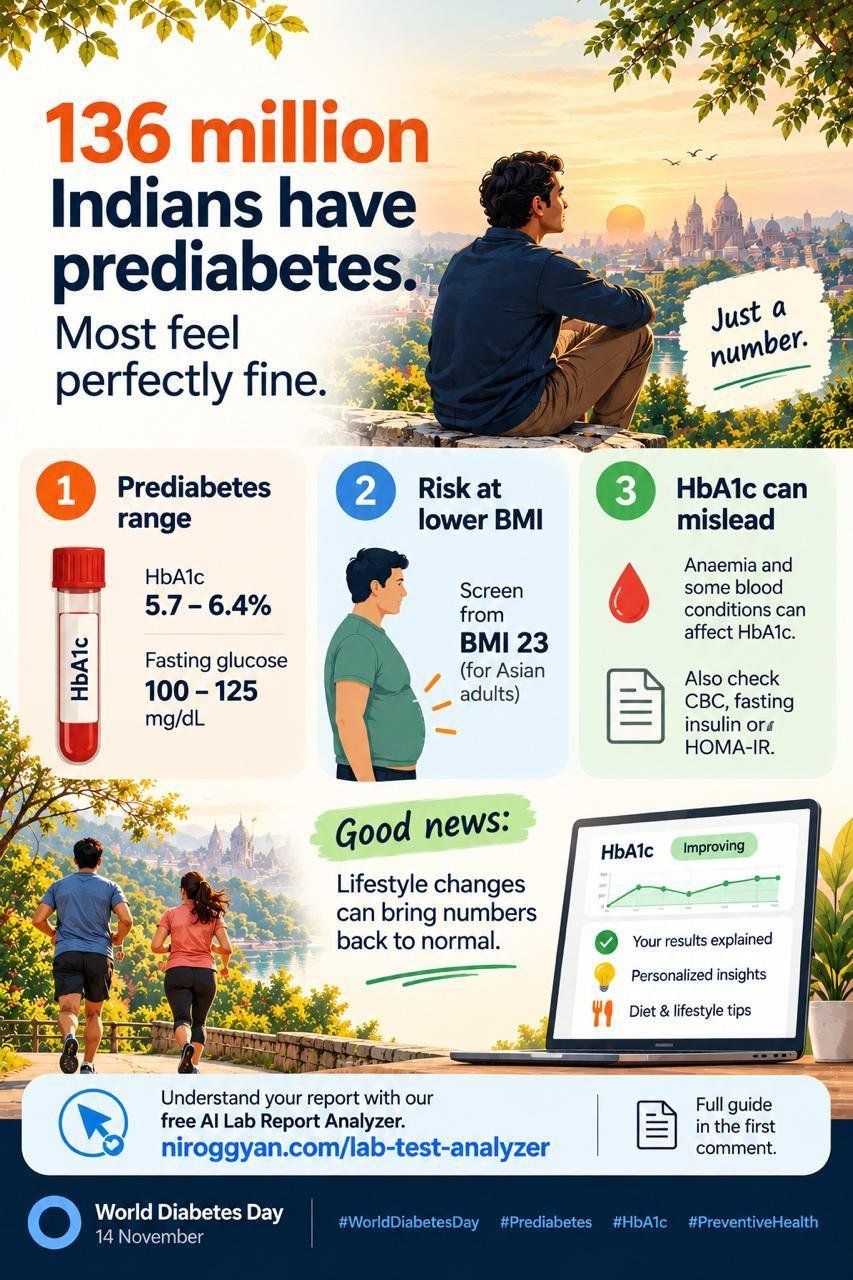
Quick answer: Prediabetes means your blood sugar is higher than normal but not yet in the diabetes range. By the American Diabetes Association (ADA) cut-offs, that is an HbA1c of 5.7% to 6.4%, or a fasting plasma glucose of 100 to 125 mg/dL. It usually causes no symptoms, so only a blood test finds it. For many people it can be improved with weight loss, food changes and regular activity, which is why finding it early matters. India's largest national study, ICMR-INDIAB, estimated about 136 million Indians with prediabetes and 101 million with diabetes (The Lancet Diabetes & Endocrinology, 2023).
Most people who have prediabetes do not know it. There is no pain, no thirst, no warning. The first sign is often a line on a lab report that nobody explains.
This guide explains that line: what HbA1c and fasting glucose measure, where the cut-offs are, why Indians can be at risk at a lower weight and with an apparently normal report, what fasting insulin and HOMA-IR add, and what to do next. It is written for someone holding a report and wondering what the numbers mean.
What is prediabetes?
Prediabetes is the stage between normal blood sugar and type 2 diabetes. Cells respond less well to insulin (insulin resistance), the pancreas works harder to compensate, and glucose starts to creep up. Doctors also use the terms impaired fasting glucose (IFG) and impaired glucose tolerance (IGT) for the two main patterns.
It is a risk state, not a disease sentence. Without changes, a large share of people with prediabetes go on to develop type 2 diabetes, but many do not, and some return to normal.
The numbers: normal, prediabetes and diabetes
These are the ADA cut-offs used by most doctors. A diagnosis of diabetes needs confirmation by a doctor, usually with a repeat test.
| Test | Normal | Prediabetes | Diabetes range |
| HbA1c | Below 5.7% | 5.7% to 6.4% | 6.5% or above |
| Fasting plasma glucose (FPG), after 8 hours without food | Below 100 mg/dL | 100 to 125 mg/dL | 126 mg/dL or above |
| 2-hour glucose on a glucose tolerance test (OGTT) | Below 140 mg/dL | 140 to 199 mg/dL | 200 mg/dL or above |
If your report shows HbA1c in mmol/mol, 5.7% is about 39 mmol/mol and 6.5% is 48 mmol/mol.
Is HbA1c the same as blood sugar? No. HbA1c, or glycated haemoglobin, shows your average blood sugar over roughly the past three months. A fasting glucose test shows your sugar at one moment, after an overnight fast. You can have one in range and the other out of range, so doctors often look at both.
What is the normal HbA1c range in India? The cut-offs are the same as the international ones above. Some Indian labs print a reference range such as 4.0% to 5.6%, which is the same normal band. Always read the range printed on your own report.
Why Indians can be at risk at a lower weight
Many people think prediabetes is a problem of obvious obesity. In Asian populations it often is not. The ADA advises testing adults with overweight, defined as a BMI of 25 or more, or 23 or more for people of Asian ancestry, who have at least one risk factor, because risk appears at a lower BMI. Two reasons are commonly given:
- Body fat distribution: Asian people tend to store more fat around the waist (visceral fat), and abdominal fat predicts diabetes better than BMI does.
- Insulin response: some Asian populations are less able to raise insulin enough to offset early insulin resistance.
The practical lesson for an Indian reader: a normal weight does not rule out prediabetes. Waist circumference matters. A waist above 90 cm in men or 80 cm in women is the cut-off commonly used for abdominal obesity in Asian Indians, so do not rely on BMI alone.
Who should be tested?
The ADA recommends testing adults with overweight and another risk factor at any age, and screening all adults from age 35. Many Indian doctors suggest starting earlier, often around 30, because diabetes tends to appear at younger ages in India. Ask for a test sooner if you have:
- a parent or sibling with type 2 diabetes
- a waistline that is large for your height, even with a normal BMI
- high blood pressure, high triglycerides or low HDL cholesterol
- a history of gestational diabetes or polycystic ovary syndrome (PCOS)
- a fatty liver on ultrasound
- dark, velvety patches on the neck or armpits (acanthosis nigricans) or many skin tags
- a sedentary job and limited exercise
What is prediabetes like day to day?
Usually, nothing at all. If you notice constant thirst, frequent urination, blurred vision, unexplained weight loss or slow-healing wounds, those can point to blood sugar that is already high, and you should see a doctor promptly.
Beyond HbA1c: the numbers that show the problem earlier
HbA1c and fasting glucose tell you where sugar is. Other markers can show that insulin resistance is building before sugar rises.
Fasting insulin and HOMA-IR
Insulin is the hormone that moves sugar from blood into cells. When cells resist it, the body makes more. A fasting insulin test measures this. HOMA-IR (homeostatic model assessment of insulin resistance) is a calculated score from fasting insulin and fasting glucose:
HOMA-IR = fasting insulin (µIU/mL) × fasting glucose (mg/dL) ÷ 405
There is no single universal cut-off. A value of about 2.5 or higher is often used to suggest insulin resistance, and an Indian study in adolescents found 2.5 gave the best balance for spotting metabolic syndrome. But the value depends on the lab, the assay and the population. A high HOMA-IR is a prompt for a conversation with your doctor, not a diagnosis.
Triglycerides, HDL and the TG:HDL ratio
Raised triglycerides and low HDL cholesterol often travel with insulin resistance. A higher triglyceride-to-HDL ratio is commonly used as a rough clue. See our guide to high triglycerides and the TG:HDL ratio.
SGPT (ALT) and fatty liver
A mildly raised ALT, also called SGPT, with no other explanation often reflects fatty liver, which is closely tied to insulin resistance. If your liver enzymes are above your lab's range, mention prediabetes risk to your doctor.
Post-meal glucose
Some people have normal fasting sugar and normal HbA1c, but their sugar rises high after meals. A 2-hour post-prandial glucose, or a formal OGTT, can show this. Ask your doctor whether it makes sense for you.
When your HbA1c may mislead you
HbA1c depends on your red blood cells, so some conditions can make it read higher or lower than your true average sugar. This matters in India, where anaemia and haemoglobin variants are common.
- Iron-deficiency anaemia can raise HbA1c.
- Vitamin B12 or folate deficiency and some other anaemias can also change it.
- Thalassaemia trait and haemoglobin variants can give unreliable results with some methods.
- Recent blood loss or transfusion can lower it.
If you have anaemia or a known blood disorder, look at your CBC (haemoglobin, MCV) alongside HbA1c, and ask your doctor whether fasting glucose or another test should be used.
Can prediabetes be reversed?
For many people, blood sugar can be brought back toward normal, and the risk of diabetes cut substantially, with lifestyle change. The best-known evidence is the US Diabetes Prevention Program, where lifestyle change (about 7% weight loss and 150 minutes of activity a week) cut the rate of new diabetes by 58% compared with placebo over an average of 2.8 years. The Indian Diabetes Prevention Programme found a smaller but real benefit in Indian adults with impaired glucose tolerance: lifestyle change lowered progression to diabetes by about 29% over roughly 30 months.
The words "reversed" and "cured" need care. Even if your numbers return to normal, the underlying risk remains, so the habits and the yearly check have to continue.
What helps, in order of impact
- Weight and waist. A loss of 5% to 7% of body weight helps many people. If your weight is already normal, focus on waist size and muscle.
- Move most days. Aim for at least 150 minutes a week of brisk walking or similar activity, plus some strength work twice a week. A 10 to 15 minute walk after meals can help lower post-meal sugar.
- Change the plate, not just the portion. Cut back on sugary drinks, sweets, maida, white bread and large portions of white rice. Add vegetables, dals and pulses, curd, nuts and whole grains. A common plate guide is half vegetables, a quarter protein and a quarter carbohydrates.
- Sleep and stress. Short sleep and long-term stress are linked with higher blood sugar.
- Stop smoking and keep alcohol low.
- Medicine when needed. Some doctors prescribe metformin to people at high risk of diabetes. That is a medical decision. Do not start or stop any medicine on your own.
How often to retest
A common rule is to repeat HbA1c and fasting glucose at least once a year if you have prediabetes, and sooner (for example in three to six months) if your doctor is checking whether a change is working. If your result was normal but you have risk factors, ask your doctor how often to repeat.
What to do with your number
| Your result | What it generally means | A sensible next step |
| HbA1c below 5.7% and fasting glucose below 100 mg/dL | In the normal range | Retest in one to three years, or sooner if you have risk factors |
| HbA1c 5.7% to 6.4% or fasting glucose 100 to 125 mg/dL | Prediabetes range | Book a doctor visit; start lifestyle changes now; retest within a year |
| HbA1c 6.5% or above or fasting glucose 126 mg/dL or above | In the diabetes range | See a doctor soon for confirmation and a plan |
| Normal HbA1c but high fasting insulin, high triglycerides or fatty liver | Possible early insulin resistance | Discuss with your doctor; lifestyle changes still help |
| Anaemia or a haemoglobin variant | HbA1c may be unreliable | Ask your doctor which test to rely on |
Read your report before you see the doctor
A diabetes checkup usually returns more than HbA1c: a CBC, lipid profile, liver function, kidney function and sometimes insulin. Understanding how they fit together makes the appointment far more useful. NirogGyan's free Lab Report Analyzer explains each value in plain language, shows whether it is in range for your age and gender, and suggests what to ask your doctor. It is for preparation, not diagnosis. For ranges, units and flags across the whole report, read How to Read a Medical Lab Report.
Don't panic, just scan. Upload your HbA1c or diabetes checkup report to the free NirogGyan Lab Report Analyzer and see what every value means in plain English.
Analyze my reportWhen to see a doctor without waiting
Contact a doctor or go to a hospital the same day for extreme thirst with frequent urination and tiredness, vomiting, confusion, fruity-smelling breath, rapid breathing, or a very high blood sugar reading. These can be signs of dangerously high blood sugar. Do not use a blog or an app as a reason to delay care.
Frequently asked questions
How common is prediabetes in India?
The ICMR-INDIAB study, published in The Lancet Diabetes & Endocrinology in 2023, estimated about 136 million Indians with prediabetes and 101 million with diabetes.
What is a good HbA1c for prediabetes?
Prediabetes is an HbA1c of 5.7% to 6.4%. The closer you are to 5.7%, the lower your risk, and the closer to 6.4%, the higher. Your doctor can tell you what to aim for.
What is the normal fasting blood sugar range?
Below 100 mg/dL after at least 8 hours without food. 100 to 125 mg/dL is the prediabetes range and 126 mg/dL or above suggests diabetes.
Can prediabetes be reversed?
Many people can bring their numbers back toward normal with weight loss, food changes and regular activity, and yearly testing is still needed afterwards.
Do I need to fast for an HbA1c test?
No. HbA1c does not need fasting. A fasting glucose and often a fasting insulin test do, for 8 to 12 hours with water only.
What is HOMA-IR?
A score calculated from fasting insulin and fasting glucose that estimates insulin resistance. There is no single universal cut-off, so your doctor interprets it.
Can I have prediabetes with a normal weight?
Yes. Asian populations can develop insulin resistance at a lower BMI and with more belly fat, so waist size and a blood test matter more than the scale.
Is HbA1c accurate if I have anaemia?
Not always. Iron-deficiency anaemia and some blood disorders can change HbA1c, so your doctor may use other tests alongside it.
Keep reading:
- Diwali health checkup: blood tests for Indian families
- Winter health checkup: 9 blood tests to do in cold weather
- High triglycerides: what your number means and why TG:HDL matters
Sources
- Metabolic non-communicable disease health report of India: the ICMR-INDIAB national cross-sectional study (ICMR-INDIAB-17), The Lancet Diabetes & Endocrinology, 2023
- Diabetes diagnosis, American Diabetes Association
- Diagnosis and Classification of Diabetes: Standards of Care in Diabetes 2026, Diabetes Care
- Reduction in the Incidence of Type 2 Diabetes with Lifestyle Intervention or Metformin, Diabetes Prevention Program Research Group, NEJM, 2002
- The Indian Diabetes Prevention Programme shows that lifestyle modification and metformin prevent type 2 diabetes in Asian Indian subjects with impaired glucose tolerance (IDPP-1), Diabetologia, 2006
- A study of insulin resistance by HOMA-IR and its cut-off value to identify metabolic syndrome in urban Indian adolescents, J Clin Res Pediatr Endocrinol, 2013
Ranges not attributed to a source above are commonly printed adult values and vary by lab, age and sex. Always use the range on your own report.
This article is for general health education and is not medical advice. It does not diagnose or treat any condition. Consult a qualified doctor about your own results.