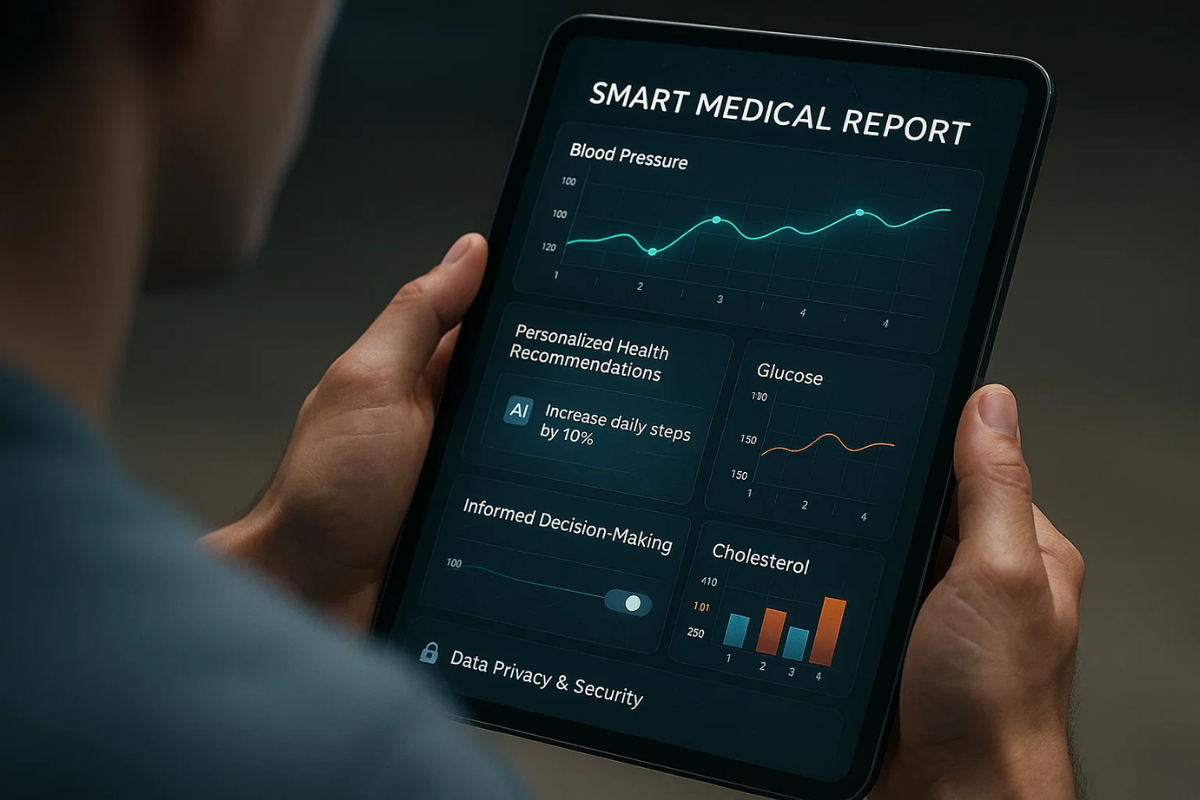
From Data to Dialogue: How Smart Medical Reports Empower Patients
Author: Joyneel Acharya
Last Updated On: 25th July 2025In the rapidly evolving landscape of digital healthcare, smart medical reports are revolutionising how patients engage with their health information. These reports convert complex health data into clear, interactive, and personalised insights, fundamentally enhancing patient understanding and engagement. Yet, this transformation is inherently tied to a more critical foundation: the uncompromising security and privacy of sensitive healthcare data. Data security in healthcare requires a proactive, multi-layered approach to protect patient confidentiality and maintain trust in this digital age. Without robust data protection, the promise of patient empowerment through smart reports remains unfulfilled.Key Highlights
- Smart medical reports convert complex health data into clear, interactive, and personalized insights, enhancing patient understanding and engagement.
- They simplify medical jargon, use visualizations like charts and graphs, and provide tailored health recommendations to support informed decision-making.
- Integration of AI and data analytics enables highlighting of key health trends, automated alerts, and seamless communication through digital health platforms.
- These reports consolidate data from multiple sources, fostering better collaboration between patients and providers and enabling faster, more accurate clinical decisions.
- By contextualizing data with explanations and actionable steps, smart reports transform patients from passive information recipients into active participants in their healthcare.
- Ensuring data privacy and security within these digital tools helps build trust and encourages ongoing patient-provider dialogue.
Understanding Smart Medical Reports and Their Role in Healthcare
Smart medical reports fundamentally transform complex health data into clear, interactive conversations between patients and providers. Unlike traditional reports filled with technical jargon, smart reports use digital visualisations and tailored insights to make health information accessible and actionable. They simplify medical jargon, use visualisations like charts and graphs, and provide tailored health recommendations to support informed decision-making. This shift is not merely about convenience; it’s about establishing a secure conduit for vital information.
Privacy regulations demand that any platform handling such sensitive data, like NirogGyan which manages diagnostic test bookings and health information, adheres to stringent privacy standards. This means employing robust encryption for user data and demonstrating compliance with regulations such as GDPR, HIPAA-compliant practices where applicable, and crucially, India’s evolving data protection laws, like the Digital Personal Data Protection Act, 2023. Our security framework ensures that as data is simplified and visualised, its underlying integrity and confidentiality are never compromised.
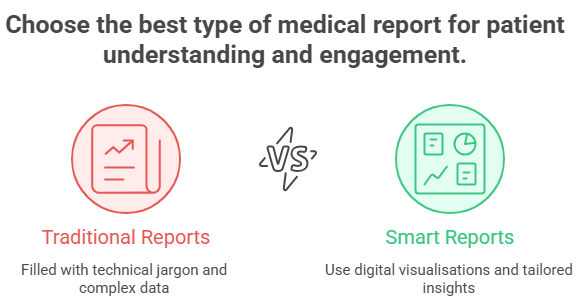
Transforming Healthcare Data into Patient-Centric Dialogue
Turning healthcare data into meaningful patient dialogue requires more than just presenting numbers; it demands context, clarity, and personalisation. Smart reports leverage advanced analytics to translate raw data into narratives that resonate with patients’ unique health journeys. By combining clinical data with patient history, lifestyle factors, and even genetic information, healthcare providers can create tailored insights that empower patients to understand their conditions deeply. This transformation helps patients move from passive recipients of information to active participants in their care.
Our security framework ensures that this intricate process of data transformation, from raw input to personalised insight, is conducted within a zero-trust architecture. This means every access request, every data transfer, and every computational step is verified and authenticated, regardless of its origin. This secure process is fundamental to creating patient-centric dialogue, ensuring that data privacy and security are upheld to build patient trust. This transformation helps patients move from passive recipients of information to active participants in their care.
Data Governance Framework: Pillars of Secure Dialogue
| Pillar | Description | Security Implications |
| Data Classification | Categorising data by sensitivity and regulatory requirements | Ensures appropriate encryption and access controls |
| Access Management | Strict controls on who can view/modify data | Prevents unauthorised access and data breaches |
| Audit Trails | Comprehensive logging of all data interactions | Enables rapid detection and response to security incidents |
| Data Retention | Policies for data storage duration and disposal | Minimises risk from obsolete data, ensures compliance |
| Consent Management | Clear patient consent for data collection and sharing | Upholds individual autonomy and legal compliance |
The Importance of Clear Patient Communication in Medical Reporting
Clear communication in medical reporting is crucial for ensuring patients understand their health status and care plans, which directly impacts outcomes and satisfaction. When medical information is conveyed in simple, jargon-free language, patients are more likely to follow treatment instructions and engage proactively in their care. This clarity empowers patients to engage actively in their care, ask informed questions, and make better decisions.
Data security in healthcare requires that this clear communication is also secure communication. Every touchpoint, from receiving the report to interacting with it, must be safeguarded. Privacy regulations demand that the digital platforms facilitating this dialogue employ robust encryption and adhere to strict data protection principles.
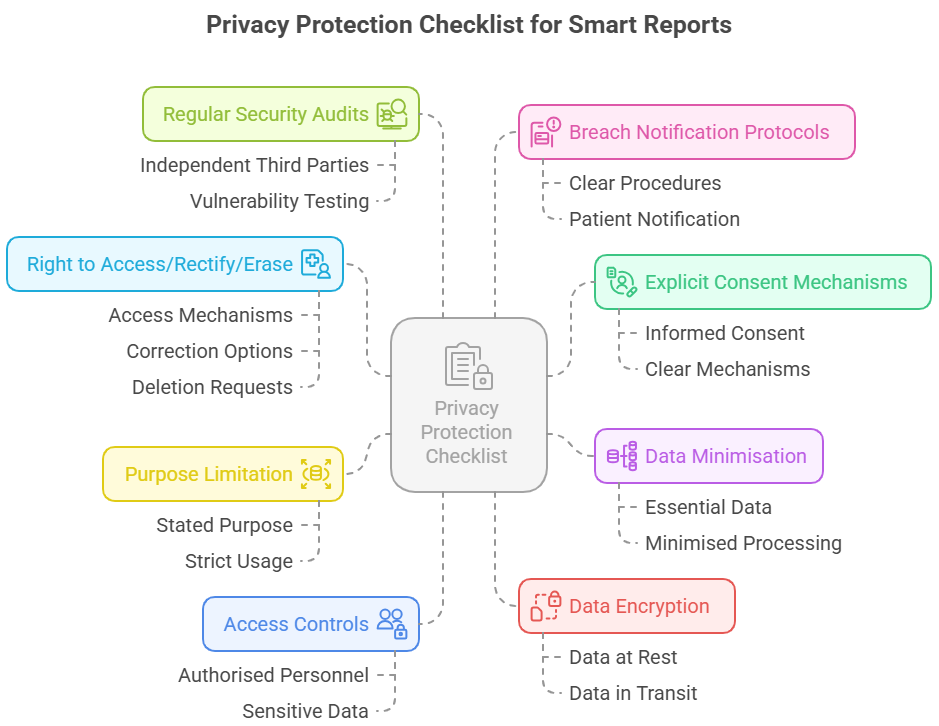
Privacy Protection Checklist for Smart Reports
- Explicit Consent Mechanisms: Are patients giving clear, informed consent for data collection and sharing?
- Data Minimisation: Is only essential data collected and processed?
- Purpose Limitation: Is data used strictly for its stated purpose?
- Access Controls: Are only authorised personnel able to access sensitive data?
- Data Encryption (At Rest & In Transit): Is all patient data encrypted both when stored and when being transferred?
- Regular Security Audits: Are systems regularly tested for vulnerabilities by independent third parties?
- Breach Notification Protocols: Are clear procedures in place for notifying patients in case of a data breach?
- Right to Access/Rectify/Erase: Do patients have clear mechanisms to access, correct, or request deletion of their data?
Leveraging Healthcare Analytics and Digital Health Technologies
Healthcare analytics and digital health technologies are transforming patient care by turning vast data into actionable insights. By analysing clinical, administrative, and patient-generated data, providers can predict disease risks, optimise treatment plans, and improve operational efficiency. Digital tools like wearable devices, telehealth platforms, and AI-powered diagnostics enhance real-time monitoring and personalised care. In India, integrating healthcare analytics with digital health initiatives supports scalable, patient-centred care, especially in rural areas.
Privacy regulations demand that as these powerful technologies are leveraged, they comply with a complex web of legal and ethical requirements. Data security in healthcare requires meticulous adherence to privacy-by-design principles, ensuring that security is built into the core of every analytic model and digital tool. This includes protecting the integrity and confidentiality of the patient data at every stage of the analytic lifecycle, from ingestion to insight generation.
Security Compliance Table: Global & Indian Contexts
| Regulation/Standard | Focus | Key Requirement for Smart Reports |
| GDPR (EU) | Data protection and privacy for EU citizens | Consent, data minimisation, right to access/erase, data breach notification. |
| HIPAA (US) | Health data privacy and security in the US | Safeguards for Protected Health Information (PHI), administrative, physical, technical. |
| DPDP Act, 2023 (India) | Comprehensive data protection in India | Consent, data fiduciary obligations, data principal rights, cross-border data transfer rules. |
| ISO 27001 | Information Security Management System (ISMS) | Establishes, implements, maintains, and continually improves ISMS. |
| NABL (India) | Diagnostic lab quality & competence | While not directly security, it provides a framework for quality in data source. |
Interoperability and Standards Supporting Smart Reports
Interoperability standards like HL7 FHIR are essential for enabling smart medical reports to seamlessly share and update patient data across healthcare systems. FHIR (Fast Healthcare Interoperability Resources) defines a common language and API structure, allowing diverse systems-labs, hospitals, pharmacies-to exchange data efficiently and securely. By using standardised data elements and messaging formats, FHIR ensures that smart reports can integrate lab results, imaging, and clinical notes in real time. This connectivity supports accurate, up-to-date insights for both patients and providers, eliminating data silos that hinder coordinated care.
Our security framework ensures that this seamless exchange is fortified. FHIR standards themselves incorporate robust security features, including OAuth 2.0 for authorisation and transport layer security (TLS) for encryption during data transfer. Data security in healthcare requires not just protocol adherence but also vigilant monitoring of APIs and integration points for vulnerabilities. Privacy regulations demand that consent for sharing data via such interoperable systems is explicit and granular, allowing patients to control precisely what information is shared and with whom.
Patient Empowerment through Smart Reports: Benefits and Outcomes
Smart reports significantly boost patient empowerment by making health information transparent, personalised, and actionable. When patients can easily access and understand their medical data, they gain confidence to manage their health proactively. This is not merely about access; it's about control. By granting patients control to update information, link wearable data, and clarify errors, smart reports foster trust and active participation. This leads to better adherence, timely interventions, and ultimately, improved health outcomes.
Data security in healthcare requires that this empowerment is rooted in absolute data integrity and confidentiality. Patients must be confident that their shared medical report (medical data) is accurate, has not been tampered with, and is only visible to authorised individuals. Our security framework ensures this through strong authentication mechanisms, audit trails, and immutable ledger technologies like blockchain (a future innovation), which guarantee data authenticity and patient control over their own health information.
Security Certification Highlight: Building Trust in Digital Health
- ISO/IEC 27001 Certified: Demonstrates a systematic approach to managing sensitive company and customer information.
- SOC 2 Type 2 Attestation: Verifies that an organisation maintains security controls over time, crucial for cloud-based health platforms.
- NIST Cybersecurity Framework Compliance: Aligns with best practices for identifying, protecting, detecting, responding to, and recovering from cyber threats.
- HITRUST CSF Certified: A robust framework specifically for the healthcare industry, aligning with HIPAA and other regulatory requirements.
The Indian Healthcare Context: Ayushman Digital Health Mission and Beyond
India’s Ayushman Bharat Digital Mission (ABDM) is revolutionising healthcare by creating a unified digital health ecosystem accessible to all citizens. At its core, ABDM provides every individual with a unique Health ID (ABHA ID), acting like a digital health locker that securely stores and shares medical records with authorised providers. This initiative addresses key challenges such as fragmented health data, limited patient access, and inefficient record sharing. Through ABDM, patients gain control over their health information, enabling seamless consultations, better continuity of care, and faster diagnosis.
Privacy regulations demand that such a monumental digital infrastructure is built on the bedrock of data protection. ABDM's secure data exchange compliant with privacy standards is a critical feature, ensuring that patient data (healthcare data) is protected while enabling seamless sharing of smart reports across providers. This national framework sets a precedent for secure digital health in a diverse and populous nation, facilitating patient communication and access to their patient reports.
Practical Examples of Smart Medical Reports in India
Smart medical reports in India are already transforming patient care by combining technology with local healthcare needs. Leading hospitals and digital health platforms are adopting AI-powered reports that integrate lab results, imaging, and patient history into easy-to-understand formats. For instance, Fortis Healthcare uses smart reports that automatically generate clinical summaries and flag critical alerts, reducing errors and speeding up diagnosis. Patients receive interactive reports via mobile apps, allowing them to track treatment progress and communicate with doctors remotely.
Another example is the integration of smart reports with the Ayushman Bharat Digital Mission (ABDM), where patients can access consolidated health records through their ABHA ID. This enables seamless sharing of smart reports across providers, improving continuity of care, especially for chronic disease management. Our security framework ensures that these practical implementations adhere to strict data governance. Whether it’s a Fortis discharge summary or a patient accessing a duplicate medical report, the underlying systems are designed to protect the confidentiality and integrity of that medical data. This commitment makes finding a "medical report near me" not just convenient, but also secure.
Challenges and Future Innovations in Smart Medical Reporting
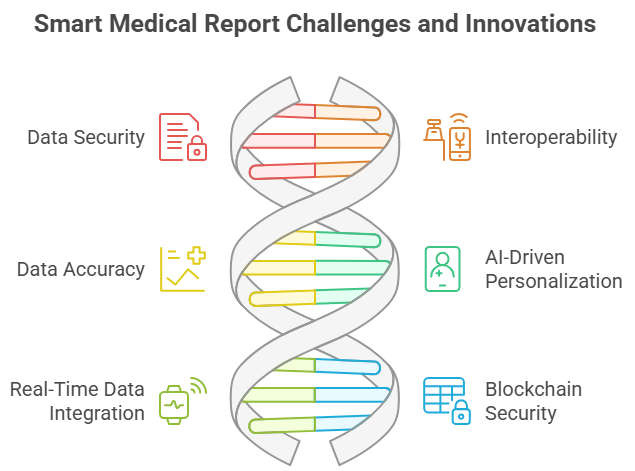
Despite their promise, smart medical reports face challenges like data security, interoperability, and patient data accuracy. Protecting sensitive health information (healthcare data) while enabling seamless data exchange remains a top priority. Fragmented healthcare systems and varying standards can hinder smooth integration, limiting report effectiveness. Additionally, managing the vast volume of health data demands advanced analytics capable of delivering timely, relevant insights without overwhelming users.
Data security in healthcare requires continuous innovation to counter evolving cyber threats. Looking ahead, future innovations like AI-driven natural language processing will further personalise reports, making them more intuitive and context-aware. Wearable and at-home devices will feed continuous real-time data, enabling dynamic updates and proactive care. Crucially, blockchain technology promises enhanced security and patient control over data sharing, offering a decentralised, immutable ledger that can fundamentally strengthen privacy and auditability for every smart report (digital medical).
Conclusion: Embracing Smart Reports for Enhanced Patient Dialogue
Embracing smart reports means transforming medical reports into clear, accessible, and interactive tools that empower individuals to take charge of their health. It’s about building trust through transparent, secure, and user-friendly systems. This evolution empowers patients to understand their health better, engage actively in decision-making, and build trust with care teams.
Privacy regulations demand that this trust is earned through demonstrable adherence to the highest standards of data protection and ethical data governance. By adopting smart reports, healthcare providers can deliver information in simple, jargon-free language, use interactive visuals to clarify health trends, provide tailored recommendations, and enable ongoing dialogue through digital platforms. Ultimately, the journey towards patient empowerment through smart reports is inseparable from the commitment to ironclad data security and unwavering patient privacy. This integrated approach elevates healthcare to a new standard of transparency, collaboration, and trust in the digital age.
Frequently Asked Questions (FAQs)
Q. What are smart medical reports and how do they differ from traditional medical reports?
Smart medical reports utilise digital tools, data analytics, and clear visualisations to simplify complex health data, making it easier to understand. This approach aims to enhance patient engagement compared to traditional reports, which are typically text-heavy.
Q. How do smart reports help empower patients in managing their health?
Smart reports contribute to patient empowerment by simplifying medical information and providing personalized insights. This process enhances a patient's understanding, encourages their active participation in their healthcare journey, and improves communication with healthcare providers.
Q. What role does digital health play in creating smart medical reports?
Digital health technologies, including Artificial Intelligence (AI), wearable devices, and telemedicine platforms, are instrumental in generating smart medical reports. These technologies collect and analyse health data in real time, supporting the creation of dynamic, patient-centric reports.
Q. How does the Ayushman Bharat Digital Health Mission support smart reporting in India?
The Ayushman Bharat Digital Health Mission provides a crucial digital health infrastructure in India. This infrastructure facilitates the seamless sharing of medical records and smart reports across various healthcare providers, thereby improving continuity of care and enhancing patient access to their health information.
Q. What standards ensure interoperability and security in smart medical reporting?
Standards such as HL7 FHIR (Fast Healthcare Interoperability Resources) are vital for ensuring interoperability and security in smart medical reporting. These standards enable secure, standardized data exchange between different healthcare systems, ensuring that smart reports can integrate diverse data sources while simultaneously maintaining patient privacy.