Last updated: September 2026 · 9 min read
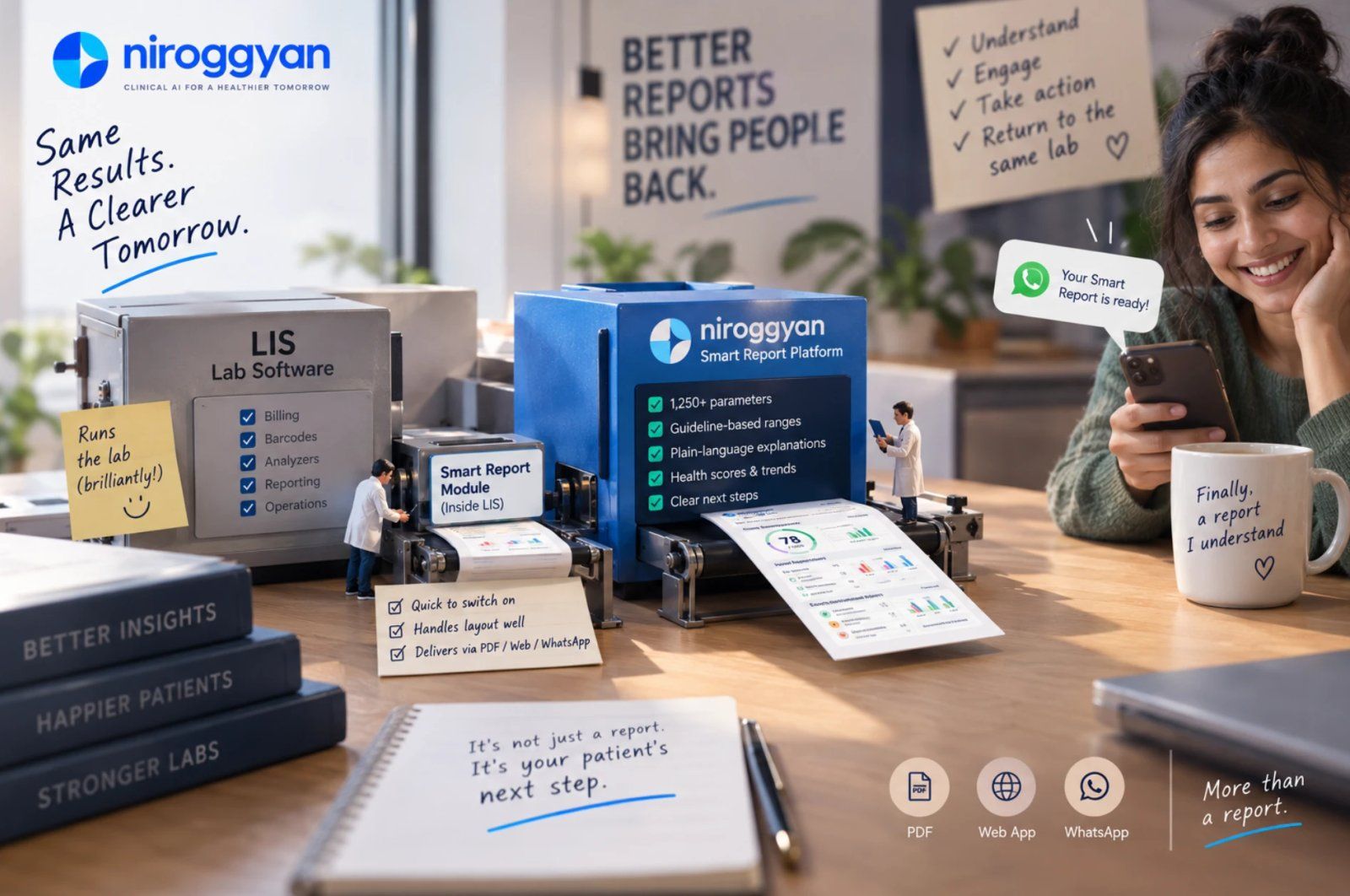
Quick answer: A smart lab report turns a test result into something your patient understands. Plain-language explanations, a health score, trends over time and clear next steps, delivered as a PDF, on the web or over WhatsApp. Labs get them in 2 ways: as a module inside their lab software, or from a dedicated smart report platform that connects to it. Modules are quick to switch on and handle layout and delivery well. Dedicated platforms go deeper on the medical content: how many of your parameters get explained, which ranges are used and how the report reads to a worried patient. If reports are part of how your lab competes, that depth is where the difference shows.
What a smart lab report actually is
Strip away the marketing and a good smart medical report has 6 parts:
- A branded cover so the patient knows whose report they're holding
- A summary that says what matters, in order
- Critical parameters first, not buried on page 4
- Plain-language explanations for every value, not just the flagged ones
- Trends across past visits, when history exists
- Next steps the patient can act on
Add a health score and your lab's branding, and that's the category. Most vendors agree on this shape. Where they differ is what goes inside the boxes.
The 2 ways labs get smart reports
| Dimension | Module inside your lab software | Dedicated smart report platform |
| Setup | Switch it on, pick a template | Connects by API or HL7, or manual upload |
| Cost | Usually bundled with your plan | Priced by report volume |
| Templates | Ready-made library | Templates by specialty, plus custom |
| Content depth | Varies; ask how many parameters are explained | The main product, so it's the main investment |
| Updates | Ships with the software roadmap | Ships whenever the medical content changes |
| Who you call | Your software support desk | A team that only does reports |
| If you change lab software | Reports usually go with it | Reports stay, you reconnect |
Neither is wrong. A lab running 200 reports a day with a simple menu may be perfectly served by a built-in module.
But it helps to know what you're buying. Lab software has to be good at a lot of things: billing, barcodes, instrument interfacing, QC, inventory, turnaround time. The patient report is one item on a long roadmap. For a dedicated platform, it's the only item.
7 questions to ask any smart report vendor
Ask us these too.
1. How many of my parameters do you actually explain?
A template library tells you how a report looks. It doesn't tell you how many of your tests come with real explanations. Ask for the number, then check it against your own menu.
2. Where do your reference ranges come from?
Published guidelines, or whatever the analyser printed? Ask which sources, and how often they're reviewed.
3. Do your ranges change with age?
A creatinine value means something different for a 6-year-old and a 60-year-old. A single adult range for everyone is a common shortcut.
4. What happens with qualitative and semi-quantitative results?
"Reactive", "Non-reactive", "1+", "2+". No colour bar explains these. Someone has to write the medical content, test by test.
5. What does the PDF look like on a phone?
In India and the GCC, your report travels on WhatsApp. If it only looks right on a desktop portal, most patients will never see it that way.
6. What can you show me about patient engagement?
Not impressions. Real numbers: how many patients open the report, how long they spend on it, whether follow-up calls to your front desk go down.
7. If I change my lab software next year, what happens to my reports?
This one catches people out. If your smart report lives inside your lab software, switching vendors means rebuilding your patient experience from scratch.
Where template libraries stop and content begins
Template galleries are genuinely useful. Picking a layout beats designing one, and component-based builders make branding easy.
But a template is a container. What determines whether your patient understands their thyroid result is the sentence underneath the number, and whether that sentence is right for their age, their value and their panel.
That content is slow, unglamorous work. At NirogGyan it's most of what we do. Our library covers 1,250+ parameters across 42 diagnostic profiles, with ranges anchored to published guidelines from Mayo Clinic, CAP, CLSI, IFCC, ADA, KDIGO, WHO and ACC/AHA, and age groups built into the logic.
We've done only this since 2019. It's why 50+ labs and hospitals use our Smart Reports, including Max Labs, PharmEasy-Thyrocare and Redcliffe Labs.
Health scores: useful, if you know how they're built
A health score gets patients to open the report. That's real value.
It's also the easiest part to get wrong. Before you ship one to thousands of patients, ask your vendor:
- Which parameters go into the score, and what weight does each carry?
- How do age and sex change it?
- What happens when 1 critical value sits among 40 normal ones? Does the score still look reassuring?
- Can you show me the calculation on paper?
If a vendor can't explain the maths, your patients are being scored by something nobody can defend to a doctor.
Who labs usually evaluate
Most labs look at 2 or 3 options.
Lab software with a built-in module. In India, the 2 best known are CrelioHealth and Drlogy. CrelioHealth's Smart Report offers a template library, health score visuals, component-based design and delivery over email, WhatsApp or print. Drlogy, which says it serves 30,000+ labs, builds its SMART Report from patient vitals such as height, weight, blood pressure and pulse, turning them into indices like BMI, body fat and BMR, with templates available in local languages.
Dedicated platforms. NirogGyan for labs in India and the GCC. Globally, BloodGPT and Docus, both compared in detail on our blog.
General AI chatbots, which patients now use on their own. We wrote about what ChatGPT gets right and wrong on lab reports.
These are 3 different products wearing one name. One starts from your report layout. One starts from the patient's vitals. One starts from the test results themselves. Before comparing prices, work out which starting point you need.
Then run the 7 questions above across your shortlist. The answers separate them faster than any feature list.
See your own report as a smart report
The fastest way to judge any of this is to look at your own menu.
Send your test list and a few sample reports to sales@niroggyan.com. We'll map every parameter to our library, tell you how many we explain today, and show you one of your own reports rebuilt as a Smart Report.
No template gallery needed. Just your report, made readable.
FAQs
What is a smart lab report?
A smart lab report presents test results in a patient-friendly format: plain-language explanations, visual indicators, a health score, trends over time and next steps. It's delivered as a PDF, in an app or on the web, alongside the standard report.
What's in a smart report template?
Most templates include a branded cover, a summary, critical parameters, trend charts, recommendations and space for lab promotions. The template controls layout. The medical content underneath is separate, and it's what decides whether patients understand their results.
Do I need lab software to send smart reports?
No. Dedicated platforms connect through HL7 or an API if you have a LIMS, and accept manual upload if you don't.
Are smart reports available in languages other than English?
Yes. Ask which languages are supported for the explanations themselves, not just the labels, and check right-to-left layouts if you serve Arabic-speaking patients.
Do smart reports actually increase patient engagement?
They can. Across NirogGyan labs, 70%+ of patients engage with their Smart Report and spend 3 to 5 minutes on it, and labs report 65% fewer follow-up queries. Ask any vendor for their equivalent numbers.
How do I see a sample smart report?
Most vendors publish samples. We'll go one better and build a sample from your own test menu, so you can judge coverage rather than design.
What does SMART stand for in a smart report?
It depends on the vendor. Some lab software uses SMART as an acronym for Self-Monitoring, Analysis and Reporting Technology, applied to patient vitals. Most of the industry uses "smart report" more broadly, to mean any patient-friendly version of a lab report.
Is a vitals-based smart report the same as a test-based one?
No. A vitals-based report uses measurements like height, weight, blood pressure and pulse to calculate indices such as BMI and BMR. A test-based report explains the actual results in your panel, parameter by parameter. Many labs want both, but only one of them explains the test the patient paid for.
What's the best option today for understanding a lab report?
A Smart Report built for lab results. It explains every value using guideline-based ranges, shows what matters most first, and includes a summary for your doctor. Ask your lab for one, or use NirogGyan's Lab Report Analyzer.
Send your test list and a few sample reports to sales@niroggyan.com. We'll show you one of your own reports rebuilt as a Smart Report.
Book a Demo