TL;DR / Quick Summary
- A historic diagnostic shift: confirming Alzheimer's pathology historically required an invasive lumbar puncture (spinal tap) or a multi-thousand-dollar radioactive amyloid PET scan. Groundbreaking clinical validation and FDA clearances have established p-tau217 blood tests as accurate, minimally invasive alternatives.
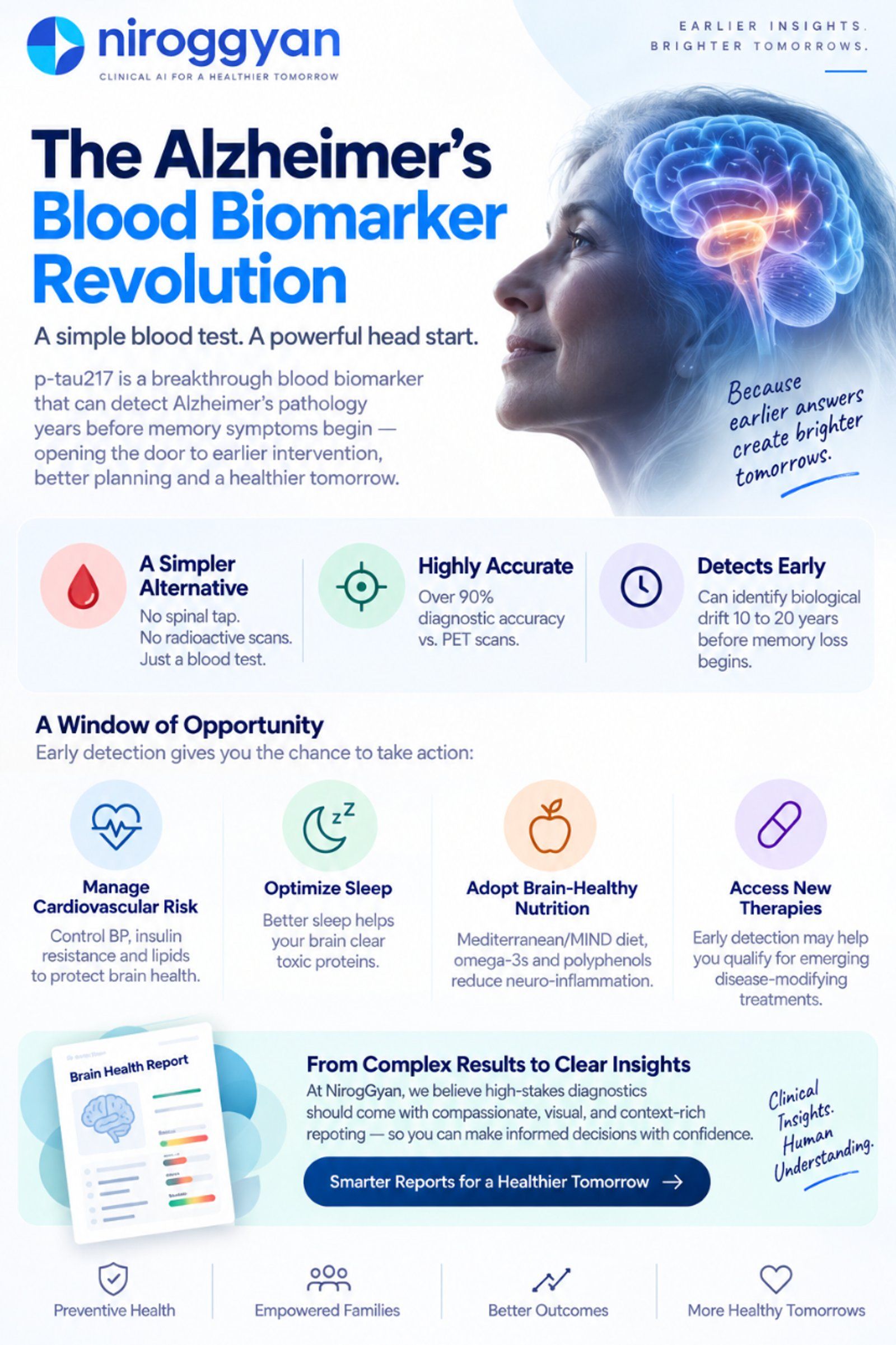
- The power of p-tau217: phosphorylated tau at position 217 (p-tau217) is a blood-based biomarker that detects the co-existence of amyloid plaques and neurofibrillary tangles in the brain with over 90% diagnostic accuracy.
- Reclaiming the clock: high plasma p-tau217 can identify biological drift 10 to 20 years before noticeable memory loss or cognitive decline begins, shifting dementia care from late-stage reaction to early prevention.
- The communication challenge: highly sensitive neurological biomarkers can cause extreme anxiety if delivered as raw, cryptic PDF scores. At NirogGyan, we believe high-stakes diagnostics must be paired with compassionate, visual, and context-rich reporting that empowers patients and families.
The Invasive Past of Neurodegenerative Diagnostics
For over a century, diagnosing Alzheimer's disease has been an agonizing, delayed process.
Historically, families watched loved ones struggle with subtle memory slips, misplaced keys, or personality shifts for years. By the time an individual walked into a neurology clinic and received a formal clinical diagnosis, substantial, irreversible neuronal loss had already occurred.
To confirm whether cognitive symptoms were caused by Alzheimer's disease or another form of dementia, clinicians had only two biological confirmation tools: a radioactive amyloid PET scan or an invasive spinal tap to draw cerebrospinal fluid.
Because of high costs, limited scanner infrastructure, and the physical discomfort of spinal needles, fewer than 10% of individuals who could benefit from early biological confirmation ever received it. Most were diagnosed purely through observational cognitive exams after millions of synapses were already lost.
The field of neurodiagnostics has now crossed a historic inflection point: the arrival of high-precision blood-based biomarkers.
What Is p-Tau217? The Molecular Mechanics Explained
The brain of an individual developing Alzheimer's disease undergoes two primary microscopic changes over decades:
- Beta-Amyloid Plaques: sticky protein fragments that accumulate outside neurons, disrupting cell-to-cell communication.
- Tau Neurofibrillary Tangles: twisted strands of tau protein that collapse the internal transport rail system inside neurons.
As amyloid plaques build up in brain tissue, they trigger an abnormal biochemical reaction: tau proteins become hyperphosphorylated at specific amino acid sites.
Among all phosphorylation sites, tau phosphorylated at threonine 217 (p-tau217) is exceptionally specific to Alzheimer's pathology:
- High Specificity: while older blood markers like p-tau181 can mildly elevate in non-Alzheimer's conditions, p-tau217 rises in direct correlation with amyloid and tau accumulation.
- Extreme Sensitivity: plasma levels of p-tau217 can surge up to 8 to 13 times higher in individuals with early Alzheimer's pathology compared to healthy controls.
- Parity with Gold Standards: large multi-center studies published in JAMA and Nature Medicine demonstrate that advanced p-tau217 assays (such as mass spectrometry and high-sensitivity immunoassays) achieve greater than 90% to 95% diagnostic concordance with amyloid PET scans and spinal fluid draws.
The regulatory clearance of platforms like C2N Diagnostics' PrecivityAD2 and Roche's Elecsys pTau217 plasma assay has officially moved blood-based neurodiagnostics out of research laboratories and into mainstream clinical practice.
Detecting Disease 10 to 20 Years Early: The Window of Opportunity
The most profound implication of blood-based p-tau217 testing is not simply that it replaces a spinal tap; it is the timeline it unlocks.
Groundbreaking longitudinal research presented at the Alzheimer's Association International Conference (AAIC) reveals that elevated plasma p-tau217 can predict cognitive impairment and dementia risk a decade or more before clinical memory symptoms manifest.
In cognitively healthy older adults, highly elevated p-tau217 indicates an estimated 78% risk of developing mild cognitive impairment (MCI) or dementia over a ten-year horizon.
This biological window completely reshapes neurodegenerative care. In the past, doctors stepped in at Year 20. With blood biomarkers, we can detect metabolic and amyloid drift at Year 5.
Catching biological vulnerability early gives individuals the opportunity to:
- Target Cardiovascular Risk: what damages micro-vessels in the heart directly damages micro-vessels in the brain. Aggressively controlling hypertension, insulin resistance, and atherogenic lipids stabilizes the blood-brain barrier.
- Optimize Sleep Architecture: the brain's glymphatic system flushes out circulating beta-amyloid and tau fragments primarily during deep, slow-wave sleep. Diagnosing and treating obstructive sleep apnea directly protects cognitive longevity.
- Adopt Neuro-Protective Nutrition: diets rich in polyphenols, omega-3 fatty acids, and low in refined sugars (such as the Mediterranean-DASH Intervention for Neurodegenerative Delay, or MIND diet) significantly reduce neuro-inflammation.
- Qualify for Targeted Therapeutics: newly developed anti-amyloid monoclonal antibodies demonstrate their highest clinical efficacy when administered during early, mild phases of disease before widespread brain atrophy occurs.
The Delivery Dilemma: Why Complex Biomarkers Need Smart Reporting
The scientific triumph of blood-based Alzheimer's testing highlights a major challenge: how do we communicate sensitive diagnostic results responsibly?
If a 56-year-old individual visits a primary care clinic with mild brain fog and receives a cold, standard PDF report stating "Plasma p-tau217 Ratio: 0.28 [HIGH / POSITIVE]," the emotional impact can be devastating. Without proper clinical framing, that person will likely hear: "You have Alzheimer's, and your mind is failing."
In reality, an elevated p-tau217 ratio is a biological risk indicator, not a definitive forecast of sudden disability. It indicates that amyloid pathology is present, but it does not mean an individual cannot live ten or fifteen vibrant, cognitively sharp years, especially if proactive interventions are initiated.
When diagnostic tests carry profound emotional and neurological weight, healthcare technology must move beyond cold black-and-white printouts.
Traditional Diagnostic Reports vs. NirogGyan's Smart Reporting Layer
The next decade of diagnostics will belong to platforms that turn complex molecular data into clear, human guidance.
| Dimension | Standard Diagnostic Lab PDF | NirogGyan Visual Smart Report Layer |
| Result Presentation | Raw numerical concentrations and decimal ratios. | Clear, intuitive visual risk spectrums (Low, Intermediate, Elevated). |
| Cognitive Framing | Binary flags that risk inducing fatalism or panic. | Educational framing emphasizing the difference between pathology and current function. |
| Multimarker Context | Isolates the marker from overall cardiovascular and metabolic health. | Links neurological biomarkers with vascular health (HbA1c, Lipids, hs-CRP, Blood Pressure). |
| Actionability | No lifestyle, cognitive, or sleep guidance provided. | Outlines proactive lifestyle strategies and evidence-based risk-reduction protocols. |
| Clinical Dialogue | Leaves patients anxious and overwhelmed during clinic visits. | Prepares families with structured, constructive questions for their neurologist. |
Frequently Asked Questions
Can a primary care doctor order a p-tau217 blood test today?
Yes. With recent regulatory clearances and commercial availability through major international diagnostic networks, physicians can order plasma p-tau217 tests for adult patients showing early signs of mild cognitive impairment or memory concerns. However, availability varies by country and regional diagnostic laboratory partnerships.
Does a positive p-tau217 test mean I have Alzheimer's disease today?
No. A positive p-tau217 test indicates the presence of amyloid plaques and tau phosphorylation in the brain, the biological hallmarks of Alzheimer's pathology. It is not a standalone diagnosis of clinical dementia. Many individuals with early amyloid pathology maintain normal cognitive function for years. It serves as a biological early warning system to guide targeted therapies and lifestyle interventions.
How does p-tau217 compare to older genetic tests like APOE-e4?
An APOE-e4 genetic test only tells you your inherited lifetime risk; it cannot tell you if the disease process has actually started in your brain. In contrast, p-tau217 is a direct, real-time protein biomarker. It measures whether active amyloid and tau pathology are physically accumulating right now, making it far more accurate for immediate clinical evaluation.
Can lifestyle changes lower Alzheimer's risk if biomarkers are elevated?
Yes. Large-scale epidemiological and clinical trials (such as the landmark FINGER study) demonstrate that aggressive management of vascular risk factors, maintaining healthy blood pressure, optimizing blood glucose, regular aerobic exercise, treating sleep apnea, and eating an anti-inflammatory diet, can slow the trajectory of cognitive decline, even in individuals with genetic or biological risk factors.
What is the difference between p-tau181 and p-tau217?
Both are phosphorylated forms of the tau protein found in human blood, but p-tau217 is significantly more accurate and specific to Alzheimer's disease. While p-tau181 levels show modest rises and can overlap with other neurodegenerative disorders, p-tau217 shows a much sharper elevation that mirrors amyloid PET scan results with over 90% accuracy.
Clarity, Dignity, and the Next Era of Diagnostics
The transition of Alzheimer's diagnostics from painful spinal taps to routine blood draws is one of the great medical milestones of our time. It represents the true promise of modern health technology: removing physical pain, dropping economic barriers, and identifying risk while there is still time to act.
At NirogGyan, we believe that as diagnostic science becomes more sensitive, human communication must become more empathetic. Whether a blood test is measuring a routine liver enzyme or a high-stakes neurological biomarker, numbers should never produce paralyzing fear.
When you give patients clear, visual context, you turn raw biological data into understanding, dignity, and a clear path forward.
Take charge of your health data with total confidence.
Upload Your Report Free