
From One-Time Customers to Loyal Patients: Increasing Retention with Smart Reporting
Author: Joyneel Acharya
Last Updated On: 26th August 2025
Is your healthcare organisation prepared to pivot from episodic care to a model of sustained patient engagement and loyalty? The competitive landscape, coupled with evolving patient expectations, demands a strategic re-evaluation of how you connect with and retain your patient base. We regularly consult with healthcare leaders who are grappling with this shift, seeking pathways to solidify patient trust and ensure continuity of care.
Key Takeaways
- Smart reporting significantly enhances patient retention by converting complex health data into personalised, easy-to-understand insights, thereby fostering active patient engagement and unwavering loyalty.
- Key retention strategies that are demonstrably improved by smart reporting include personalised communication, timely intervention alerts, and data-driven patient education.
- Persistent patient retention challenges, such as scheduling conflicts, suboptimal communication, and the perceived lack of personalised care, can be effectively addressed through data-driven insights and proactive engagement models.
- Smart reporting leverages advanced AI capabilities to meticulously analyse and visualise medical data, simplifying intricate information for both patients and providers with interactive summaries and meticulously tailored health guidance.
- Essential features of smart reporting tools encompass AI-powered interpretation, real-time monitoring dashboards, automated compliance reports, and seamless integration across your existing healthcare systems.
- The integration of real-time data from wearables into smart reports enables early intervention, substantially reducing no-show rates and promoting consistent patient follow-ups.
In the digital era, patient experience extends far beyond the clinic walls. Smart reporting fundamentally transforms patient retention by converting complex health data into personalised, easy-to-understand insights. This strategic move empowers your patients to actively engage in their own care journey, fostering trust and loyalty that extends well beyond the initial visit. By leveraging these sophisticated smart reports, your healthcare providers gain the unparalleled ability to identify individual patient needs, proactively anticipate health risks, and tailor follow-up interventions accordingly.
Here’s how to implement a foundational shift in your retention strategy:
Before You Digitise: A Digital Readiness Assessment for Patient Retention
Before embarking on any technological integration, an honest assessment of your current operational capabilities and strategic objectives is paramount.
| Assessment Area | Our Expert Observation |
| Current Patient Communication | Is it generic or deeply personalised? Are you using multiple channels effectively? |
| Data Collection & Silos | How effectively do you collect and integrate patient data from various sources (EHR, CRM, etc.)? |
| Follow-up Protocols | Are your follow-ups reactive or proactively driven by patient data? |
| Patient Engagement Metrics | Do you consistently measure patient satisfaction, adherence, and retention rates? |
| Staff Digital Literacy | Are your teams equipped and trained to embrace new digital tools and data-driven workflows? |
For instance, the integration of real-time updates from wearable devices into smart reports enables your providers to intervene early, significantly reducing no-shows and encouraging more regular check-ins. This data-driven approach not only leads to superior patient outcomes but also meticulously builds lasting relationships.
Understanding Patient Retention and Its Challenges in Healthcare

As a healthcare leader, you understand that patient retention is not merely about repeat visits; it is an essential metric for sustained healthcare success. Yet, it frequently presents itself as a complex, multifaceted challenge for many providers. True retention reflects an ongoing narrative of patient trust, unwavering satisfaction, and profound engagement. What specific obstacles are currently hindering your ability to cultivate this loyalty?
Common Barriers to Retention: Expert Observations
We observe that common barriers include inconvenient appointment scheduling systems, limited or inconsistent follow-up communication, and, critically, patients' perception that their condition isn’t improving or that their care isn’t tailored to them. Furthermore, logistical issues, such as transportation difficulties, and a lack of genuinely personalised care, contribute significantly to patient drop-off rates.
Healthcare leaders ask us: "How can we move beyond simply reacting to patient attrition and instead proactively build an ecosystem of loyalty?" Our answer lies in understanding the nuanced challenges:
- Scheduling conflicts and accessibility issues that deter seamless patient journeys.
- Insufficient, generic patient-provider communication that fails to resonate with individual needs.
- Patients often feel undervalued or misunderstood, leading to disengagement.
- A conspicuous lack of tailored care plans that genuinely address individual patient needs and preferences.
Addressing these challenges necessitates a strategic pivot towards data-driven insights and proactive engagement strategies to forge lasting patient relationships and, ultimately, improve population health outcomes.
What is Smart Reporting and How Does It Work in Healthcare?
Smart reporting, at its core, is a transformative technology that converts complex medical data into clear, personalised health insights that both patients and providers can easily comprehend. It harnesses AI-driven technology to meticulously analyse lab results, biometric data, and clinical records, presenting them with intuitive visual aids like charts and colour codes. This intelligent simplification of medical jargon makes health information not only accessible but genuinely actionable for all stakeholders.
Here's how to implement Smart Reporting for Foundational Insight:
Strategically, smart reports facilitate seamless data exchange across various departments within your organisation, supporting collaborative diagnosis and optimising treatment pathways. They also integrate personalised recommendations, empowering patients to manage their health proactively. Consider, for instance, how a smart report could highlight critical trends in a patient’s blood sugar levels and, crucially, suggest specific, actionable lifestyle adjustments, thereby significantly improving patient engagement and adherence to treatment protocols.
Key features of smart reporting that you should prioritise include:
- AI-powered data interpretation
- Interactive, highly visual summaries
- Tailored health guidance
Technology Stack Comparison: Integrating Smart Reporting
Successfully deploying smart reporting means integrating it into your existing technology landscape.
| Technology Component | Role in Smart Reporting | Integration Needs | Key Vendor Examples (Illustrative) |
| Electronic Health Records (EHR) | Source of primary clinical data (diagnoses, treatments, notes) | APIs for data extraction, interoperability standards (e.g., FHIR) | Epic, Cerner, Meditech |
| Customer Relationship Management (CRM) | Stores patient communication history, preferences, and engagement data | APIs for bi-directional data flow, automated task creation | Salesforce Health Cloud, Microsoft Dynamics 365 |
| Business Intelligence (BI) Tools | Visualisation dashboards, ad-hoc querying, basic reporting (can be enhanced by AI in smart reporting) | Data warehousing, connectors to EHR/CRM | Tableau, Power BI, QlikView |
| AI/Machine Learning Engines | Core of smart reporting for data interpretation, predictive analytics, personalised recommendations | Integration with BI tools and direct data feeds from EHR/CRM | Google AI, AWS ML, custom models |
| Wearable/IoT Devices | Real-time health data capture (fitness, vitals, sleep) | Secure data ingestion platforms, APIs for data streaming | Apple HealthKit, Google Fit, various medical IoT platforms |
Key Features of Smart Reporting Tools
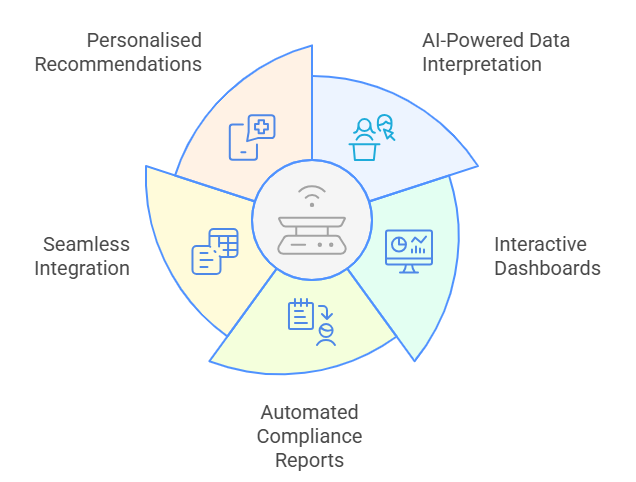
Leading-edge smart reporting tools strategically combine AI-driven analysis with intuitive visualisation to render your healthcare data genuinely actionable and accessible. These sophisticated tools are designed to automatically interpret complex medical information, meticulously highlighting critical parameters, such as lab results or vital signs, with clear visual cues and dynamic colour coding. This level of clarity empowers both your providers and your patients to swiftly grasp health trends and identify potential concerns.
Before you digitise: Expert observation on feature prioritisation: When selecting smart reporting tools, avoid feature bloat. Prioritise capabilities that directly address your identified patient retention challenges and align with your organisational workflows.
The key features you should expect from high-calibre smart reporting tools include:
- AI-powered data interpretation that intelligently adapts to individual patient histories and evolving health profiles.
- Interactive dashboards featuring dynamic charts and proactive alerts for real-time monitoring of critical patient metrics.
- Automated compliance and summary reports that significantly reduce administrative burdens and reclaim valuable staff time.
- Seamless integration with your healthcare CRM and various medical devices to ensure a unified, holistic view of patient data.
- Personalised recommendations meticulously generated based on analysed trends and patient-specific data.
For example, a strategically deployed smart report can instantly flag abnormal lab values, prompting timely provider intervention and demonstrably improving patient outcomes.
Implementation Checklist: Essential Features for Your Smart Reporting Solution
Ensure your chosen solution includes:
- AI-powered predictive analytics for patient risk stratification.
- Customisable, real-time dashboards for various user roles (clinicians, administrators, patients).
- Seamless integration with your EHR and CRM systems.
- Automated generation of patient summaries and follow-up reminders.
- Secure, compliant data handling (e.g., adhering to GDPR, HIPAA-compliant practices, and India's DPDP Act 2023).
- Multilingual support for diverse patient populations.
Retention Strategies Enhanced by Smart Reporting
Smart reporting provides your healthcare providers with the strategic tools to implement highly targeted retention strategies by harnessing precise patient data and sophisticated predictive analytics. This capability enables the creation of personalised care plans and the deployment of timely interventions that genuinely resonate with individual patient needs, thereby significantly boosting loyalty and fostering enduring relationships.
Here's how to implement an enhanced retention framework:
We advocate for a framework where smart reporting is integrated at every touchpoint of the patient journey:
- Patient Onboarding: Use initial data to generate a baseline smart report, setting expectations for personalised care.
- Ongoing Care Management: Leverage real-time data for dynamic care plan adjustments and proactive monitoring.
- Preventive Care & Wellness: Utilise smart reports for data-driven educational content and personalised wellness programme recommendations.
- Post-Treatment Follow-up: Automate reminders and check-ins based on recovery progress and potential risks.
Key strategies that are consistently enhanced by smart reporting include:
- Personalised outreach meticulously crafted based on real-time health insights and patient preferences.
- Automated reminders and follow-ups precisely tailored to individual patient behaviour and care pathways.
- Data-driven educational materials specifically addressing a patient's conditions and health literacy levels.
- Proactive risk detection that triggers early provider engagement, potentially preventing adverse events or missed appointments.
- Deep integration with CRM systems for seamless tracking of comprehensive patient history and interactions.
For instance, your team can leverage smart reports to identify patients at a heightened risk of missing appointments, subsequently sending customised reminders that significantly reduce no-shows and enhance the continuity of care.
Leveraging Healthcare CRM and Analytics for Better Patient Engagement
The synergistic combination of a robust Healthcare CRM and advanced analytics is the engine that drives deeper patient engagement within your practice. By centralising comprehensive patient data and meticulously analysing behavioural patterns, your providers can tailor outreach efforts that genuinely resonate with individual needs, leading to improved satisfaction and adherence to treatment plans.
Healthcare leaders ask us about: "Our patient data is fragmented across systems. How can CRM and analytics truly give us a unified view?" This is a common challenge, but integrating smart reporting acts as the connective tissue.
Key ways CRM and analytics collectively enhance engagement:
- Automated appointment reminders that significantly reduce no-show rates.
- Personalised care plans dynamically generated and refined based on an individual patient's history and evolving needs.
- Proactive follow-ups intelligently triggered by insights derived from health analytics.
- Educational content specifically tailored to individual patient conditions and learning preferences.
For example, a well-configured CRM system can alert your staff to proactively reach out when analytics detect a patient’s declining health metrics, fostering early intervention that can be critical for positive outcomes. Integrating your CRM with advanced analytics tools fundamentally transforms raw data into actionable insights, making every patient interaction more meaningful and demonstrably effective.
Benefits of Using Smart Reporting to Increase Patient Loyalty
Smart reporting is a powerful catalyst for boosting patient loyalty by enhancing communication, fostering transparency, and delivering truly personalised care. By transforming complex health data into clear, actionable insights, your patients feel more informed and more deeply involved in their own care journey. This unparalleled transparency builds profound trust, actively encouraging patients to remain engaged and return for ongoing treatment.
Transformation Roadmap: Achieving Patient Loyalty with Smart Reporting
| Phase | Duration | Key Objectives | Smart Reporting Integration Points | Expected Outcomes |
| Phase 1: Foundation & Data Audit | 1-3 months | Assess current data infrastructure, identify silos, define key retention metrics. | Implement core data connectors, establish initial dashboards. | Clear understanding of data landscape, baseline retention metrics. |
| Phase 2: Pilot & Personalisation | 3-6 months | Pilot smart reporting for a specific patient segment, refine personalised content. | Roll out personalised patient reports, automate targeted reminders. | Increased patient engagement in the pilot group, improved adherence. |
| Phase 3: Integration & Expansion | 6-12 months | Integrate fully with EHR/CRM, expand to all patient segments, train all staff. | Full automation of follow-ups, proactive risk detection across the board. | Significant reduction in no-shows, higher patient satisfaction, enhanced loyalty. |
| Phase 4: Optimisation & Predictive Analytics | 12+ months | Refine algorithms, leverage predictive analytics for proactive care, continuous improvement. | Advanced AI for anticipating patient needs, optimising resource allocation. | Sustainable loyalty, improved health outcomes, demonstrable operational efficiencies. |
Key benefits you will realise through smart reporting include:
- Reduced no-shows through the deployment of timely, deeply personalised reminders that resonate with patients.
- Improved patient adherence to treatment plans via tailored health recommendations and clear guidance.
- Enhanced satisfaction stemming from clear, empathetic communication and a transparent care journey.
- Proactive risk detection enables early interventions that prevent escalation of conditions or disengagement.
For example, smart reports that highlight critical health trends and suggest specific lifestyle adjustments empower your patients to take greater control over their health, fostering a significantly stronger patient-provider relationship and cultivating long-term loyalty.
Implementing Smart Reporting in Your Healthcare Practice: Best Practices

The successful implementation of smart reporting within your practice hinges on three critical pillars: customisation, seamless integration, and comprehensive staff training. We advise you to begin by meticulously tailoring reports to your practice’s specific needs, with a keen focus on clear visuals and patient-friendly language. Furthermore, ensure that you integrate smart reporting tools seamlessly with your existing healthcare CRM and Electronic Health Records (EHR) to guarantee a smooth, uninterrupted data flow across all departments.
Before you digitise: Expert observation on cultural shift: Implementation is as much about technology as it is about culture. Prepare your team for a data-driven mindset shift.
Best practices for a successful smart reporting rollout include:
- Involve clinicians early in the process to meticulously align reports with existing clinical workflows, ensuring adoption.
- Utilise dashboards that prominently highlight key patient metrics for rapid, informed decision-making.
- Thoroughly train all staff on interpreting reports and effectively communicating insights to patients.
- Regularly update report templates based on invaluable feedback and evolving patient needs.
For example, customising reports to flag high-risk patients can prompt timely interventions, leading to improved outcomes and enhanced retention rates.
Overcoming Common Implementation Challenges
Successful smart reporting implementation invariably requires addressing key hurdles such as data integration, fostering user adoption, and ensuring paramount security. Healthcare data often originates from a myriad of diverse sources, EHRs, wearables, laboratory systems making data standardisation absolutely essential. Adopting interoperability standards, such as FHIR (Fast Healthcare Interoperability Resources), can significantly simplify data exchange and markedly improve report accuracy.
Healthcare leaders ask us: "How do we ensure our data is secure and compliant, especially with evolving regulations?" This is a critical concern, and we emphasise a proactive, layered security approach. While NirogGyan states adherence to data privacy regulations (e.g., GDPR, HIPAA-compliant practices where applicable) and robust encryption, for your organisation, independent verification and specific compliance with India's DPDP Act 2023 is crucial.
Common challenges and our recommended strategic solutions include:
- User Training: Proactively equip staff with the necessary computer skills and provide clear, concise guidelines to ease their transition into new workflows.
- Data Privacy: Implement robust, multi-layered security protocols to comply with all relevant regulations and meticulously protect sensitive patient information.
- System Integration: Leverage cloud-native architectures and open APIs for seamless connection between your smart reporting tools and all existing systems.
For example, involving your clinicians early in the customisation of interfaces significantly boosts their acceptance and ensures that reports are perfectly aligned with clinical workflows, thereby reducing resistance and mitigating potential errors.
Implementation Checklist: Mitigating Challenges
- Conduct a thorough data audit to identify integration points and data quality issues.
- Develop a comprehensive staff training programme, including hands-on workshops and continuous support.
- Implement a robust data governance framework and privacy impact assessments.
- Allocate resources for ongoing maintenance and system updates.
- Engage a dedicated change management team to smooth the transition.
Conclusion: Embracing Smart Reporting for Sustainable Patient Retention
Smart reporting is unequivocally a game-changer for sustainable patient retention, empowering both providers and patients with clear, personalised health insights. By strategically simplifying complex data into actionable information, smart reports foster invaluable trust, significantly improve communication, and actively encourage proactive care. This holistic approach inevitably leads to higher patient satisfaction and enduring loyalty over time.
Here's how to implement a forward-looking strategy for sustainable retention:
To fully capitalise on these benefits and secure your organisation’s future in the digital health landscape, your healthcare practice must decisively:
- Integrate smart reporting comprehensively with your CRM and EHR systems, creating a unified and intelligent data ecosystem.
- Customise reports meticulously to individual patient needs and clinical workflows, ensuring relevance and impact.
- Train staff rigorously to effectively utilise these insights for timely, deeply personalised follow-ups that strengthen patient bonds.
For example, consistently delivering easy-to-understand reports with tailored health tips helps patients feel genuinely valued and deeply engaged, which is crucial for reducing no-shows and boosting long-term retention.
Embracing smart reporting is not merely a technological upgrade; it represents a strategic, patient-centered shift that drives lasting relationships and positions your organisation as a leader in healthcare innovation. The future of healthcare is personalised, proactive, and deeply connected. Are you ready to lead the way?
Frequently asked questions (FAQs)
1. What is smart reporting in healthcare?
Smart reporting in healthcare refers to the use of AI-driven tools that analyze and visualize complex medical data into clear, personalized reports. These reports help both providers and patients understand health information better, enabling improved decision-making and patient engagement.
2. How does smart reporting improve patient retention?
Smart reporting improves patient retention by providing personalized insights and timely alerts that facilitate proactive care. It enables healthcare providers to tailor communication, send reminders, and intervene early, which enhances patient satisfaction and encourages ongoing engagement.
3. What are effective retention strategies supported by smart reporting?
Effective retention strategies enhanced by smart reporting include personalized patient communication, automated follow-ups, data-driven patient education, and proactive risk detection. These strategies help build trust and loyalty by addressing individual patient needs.
4. How can healthcare analytics and CRM tools support patient loyalty?Healthcare analytics combined with CRM tools centralize patient data and analyze behavior patterns to deliver personalized, timely outreach. This integration helps providers engage patients more effectively, improving adherence to treatments and fostering long-term loyalty.
5. What challenges might healthcare providers face when implementing smart reporting?
Challenges include integrating diverse data sources, ensuring data privacy and security, training staff to use new tools, and adapting workflows to incorporate smart reporting insights. Addressing these challenges with proper planning and support is essential for successful implementation.“Get personalized health insights from your medical reports - check with NirogGyan today.”